Preface to the Instructor
This fifth edition of Physics for Scientists and Engineers: A Strategic Approach continues to build on the research-driven instructional techniques introduced in the first edition and the extensive feedback from thousands of users. From the beginning, the objectives have been:
To produce a textbook that is more focused and coherent, less encyclopedic.
To integrate proven results from physics education research into the classroom in a way that allows instructors to use a range of teaching styles.
To provide a balance of quantitative reasoning and conceptual understanding, with special attention to concepts known to cause student difficulties.
To develop students’ problem-solving skills in a systematic manner.
A more complete explanation of these goals and the rationale behind them can be found in my paperback book, Five Easy Lessons: Strategies for Successful Physics Teaching. Please request a copy from your local Pearson sales representative if it is of interest to you (ISBN 978-0-805-38702-5).
What’s New to This Edition
The fifth edition of Physics for Scientists and Engineers continues to utilize the best results from educational research and to tailor them for this course and its students. At the same time, the extensive feedback we’ve received from both instructors and students has led to many changes and improvements to the text, the figures, and the end-of-chapter problems. Changes include:
The Chapter 6 section on drag has been expanded to include drag in a viscous fluid (Stokes’ law). The Reynolds number is introduced as an indicator of whether drag is primarily viscous or primarily inertial.
Chapter 14 on fluids now includes the flow of viscous fluids (Poiseuille’s equation) and a discussion of turbulence.
An optional Advanced Topic section on coupled oscillations and normal modes has been added to Chapter 15.
Chapter 20 now includes an extensive quantitative section on entropy and its application.
A vector review has been added to Chapter 22, the first electricity chapter, and the worked examples make extra effort to remind students how to work with vectors. Returning to vectors after not having used them extensively since mechanics is a stumbling block for many students.
The number of applications illustrated with sidebar figures has been increased and now includes accelerometers, helicopter rotors, quartz oscillators, laser printers, and wireless chargers.
There are more than 400 new or significantly revised end-of-chapter problems. Scores of other problems have been edited to improve clarity. Difficulty ratings have been recalibrated based on Mastering® Physics.
Several substantial new Challenge Problems have been added to cover interesting and contemporary topics such as gravitational waves, normal modes of the carbon dioxide molecule, and Bose-Einstein condensates.
Textbook Organization
Physics for Scientists and Engineers is divided into eight parts: Part I: Newton’s Laws, Part II: Conservation Laws, Part III: Applications of Newtonian Mechanics, Part IV: Oscillations and Waves, Part V: Thermodynamics, Part VI: Electricity and Magnetism, Part VII: Optics, and Part VIII: Relativity and Quantum Mechanics. Note that covering the parts in this order is by no means essential. Each topic is self-contained, and Parts III–VII can be rearranged to suit an instructor’s needs. Part VII: Optics does need to follow Part IV: Oscillations and Waves; optics can be taught either before or after electricity and magnetism.
The complete 42-chapter version of Physics for Scientists and Engineers is intended for a three-semester course. A two-semester course typically covers 30–32 chapters with the judicious omission of a few sections.
There’s a growing sentiment that quantum physics is becoming the province of engineers, not just physicists, and that even a two-semester course should include a reasonable introduction to quantum ideas. I’ve written the book with the hope that an increasing number of instructors will choose one of these routes.
Complete rental edition (ISBN 9780136956297/0136956297): Chapters 1–42.
Modified Mastering with eText (ISBN 9780137319497/0137319495): Chapters 1–42.
Volume 1 rental edition (ISBN 9780137346387/0137346387) covers mechanics, waves, and thermodynamics: Chapters 1–21.
Volume 2 rental edition (ISBN 9780137346479/0137346476) covers electricity and magnetism, optics, and relativity: Chapters 22–36.
Volume 3 rental edition (ISBN 9780137346486/0137346484) covers relativity and quantum physics: Chapters 36–42.
More purchase options are available for students at www.pearson.com.
The Student Workbook
A key component of Physics for Scientists and Engineers: A Strategic Approach is the accompanying Student Workbook. The workbook bridges the gap between textbook and homework problems by providing students the opportunity to learn and practice skills prior to using those skills in quantitative end-of-chapter problems, much as a musician practices technique separately from performance pieces. The workbook exercises, which are keyed to each section of the textbook, focus on developing specific skills, ranging from identifying forces and drawing free-body diagrams to interpreting wave functions.
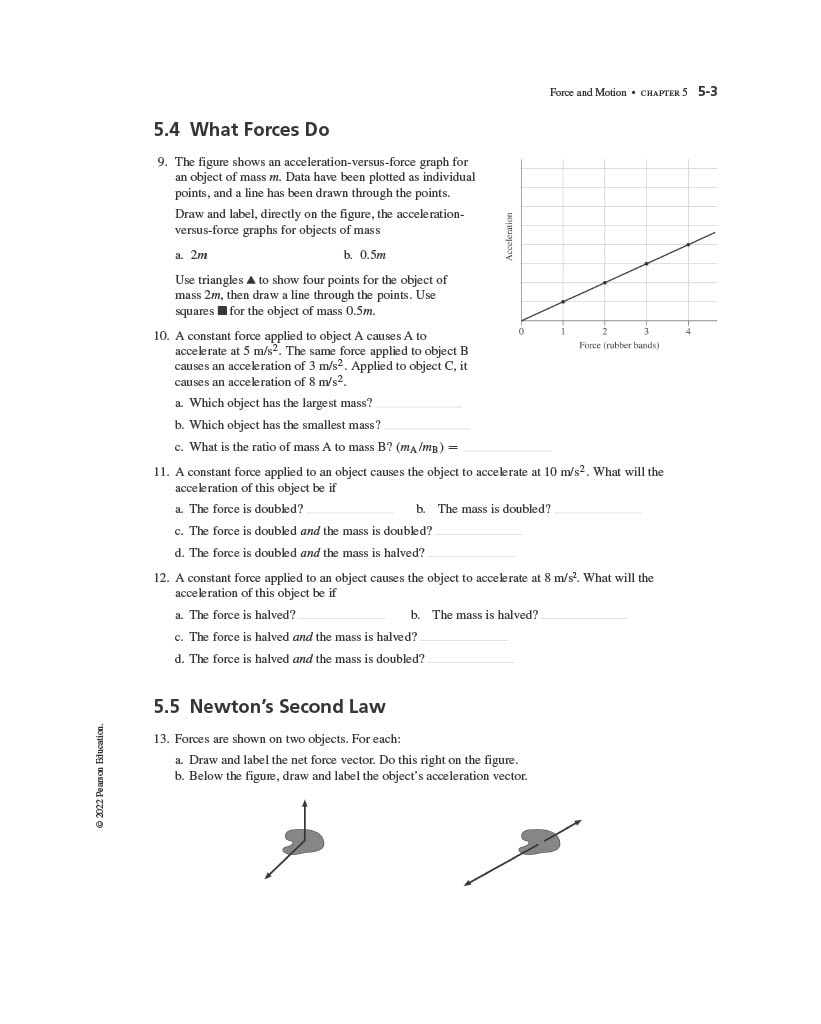
The workbook exercises, which are generally qualitative and/or graphical, draw heavily upon the physics education research literature. The exercises deal with issues known to cause student difficulties and employ techniques that have proven to be effective at overcoming those difficulties. The workbook exercises can be used in class as part of an active-learning teaching strategy, in recitation sections, or as assigned homework.
Instructor Resources
A variety of resources are available to help instructors teach more effectively and efficiently. These can be downloaded from the Instructor Resources area of Mastering® Physics.
Mastering® Physics is Pearson’s online homework system through which the instructor can assign pre-class reading quizzes, tutorials that help students solve a problem with hints and wrong-answer feedback, direct-measurement videos, and end-of-chapter questions and problems. Instructors can set up their own assignments or utilize pre-built assignments that have been designed with a balance of problem types and difficulties.
PowerPoint Lecture Slides can be modified by the instructor but provide an excellent starting point for class presentations. The lecture slides include QuickCheck questions.
QuickCheck “Clicker Questions” are conceptual questions, based on known student misconceptions, for in-class use with some form of personal response system. They are designed to be used as part of an active-learning teaching strategy.
The Instructor’s Solution Manual is available in both Word and PDF formats. We do require that solutions for student use be posted only on a secure course website.
All of the textbook figures, key equations, Problem-Solving Strategies, Tactics Boxes, and more can be downloaded.
The TestGen Test Bank contains over 2000 conceptual and multiple-choice questions. Test files are provided in both TestGen® and Word formats.