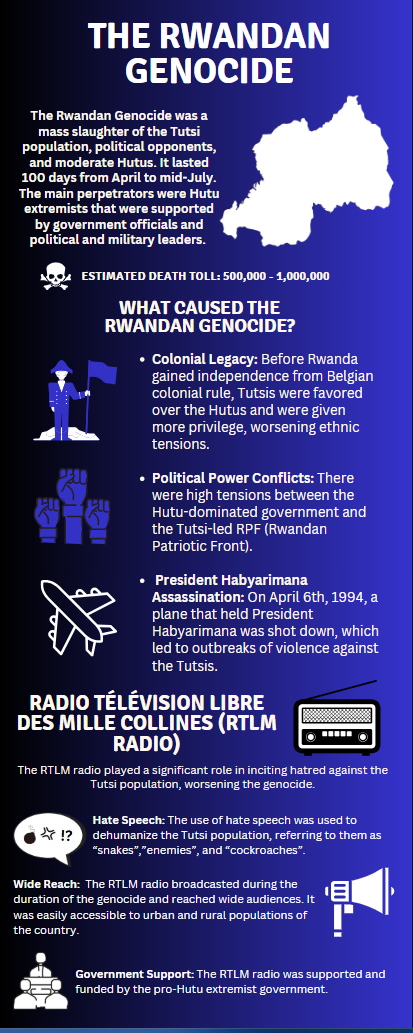
infographic about the Rwandan genocide
Jenna Sokolowski
UN 1015
Fall 2024
Professor Hoover
To whom it may concern,
This final portfolio consists of various works I have completed over taking this composition course. The content I have written allowed me to exercise the pre-existing writing skills I had and acquire new ones. I have compiled four writing works which consist of a revised comparative source analysis, a revised annotated bibliography, a journal article, and an infographic. While making this content, I have developed a deeper understanding of evaluating information, writing with context in mind, properly researching, reflecting, and revising my writing work.
As I reflect on my learning throughout the course, I would like to say that I have made significant strides in improving my writing skills. A good skill that I have improved is finding effective and ethical sources for my work that enhance my writing and help support my arguments. Before taking this class I struggled to find academic journals and sources that are relevant to the topics I research. Taking the time to find proper sources not only makes my writing more credible but also more insightful and compelling. I have been very deliberate in my writing and research approaches and understand how they can strengthen my argument and support the main points in my writing without altering my personal writing style. I have learned to write academically while keeping my authenticity and not sounding too robotic, but informative and clear. Writing my journal article helped me embrace my voice and helped me understand that I do not need to sacrifice my character for a piece of writing to sound academic. Another skill I have improved is taking constructive criticism and using it to improve my writing. For example, my annotated bibliography was missing a lot of information, including a proper introductory synthesis and further context regarding the sources I chose.
For my future college and career plans, I am not entirely sure that I will encounter many writing tasks. Despite it not being a skill that I will use often in the future, I think learning to effectively write, evaluate information, and communicate will be crucial skills to know for any workforce. Improving my writing has helped me with other factors, such as improving my media comprehension and arguing skills. Knowing how to write concise and well-supported work is a valuable skill regardless of the career path I choose. The continued goals I have as a writer are to continue learning and improving my work and consider possibly writing creatively in the future. I do like to write and I want to be able to exercise that. I have a lot of interest in history-related topics and I enjoy researching and writing about the subjects I am passionate about.
Overall, this portfolio serves as a way to highlight the progress I have made throughout the year. Taking a college-level writing class has opened my mind to new writing, reading, and comprehension skills that will be valuable for the rest of my school career. I am personally satisfied with the improvements I have made compared to my earlier drafts and am excited to share the writings I have invested in.
Thank you for taking the time to read and evaluate my work.
Sincerely,
Jenna Sokolowski
The purpose of this comparative source analysis was to compare and contrast different sources that explored the effects of propaganda and hate speech during the Rwandan genocide. An interview with Immaculée Ilibagiza, who shares her experiences with the genocide, and an academic article that provided quantitative data were chosen for the analysis. The feedback I have received from peers was positive regarding the writing and format, however, I had minor grammatical errors that I needed to fix. The feedback I have received for this analysis improved the clarity of my writing. After making minor changes, I noticed that the clarity and the flow of sentences in my analysis have improved. Writing a comparative source analysis essay allowed me to consider researching from various sources beyond academic articles and journals. I found Immaculée Ilibagiza’s interview to be very insightful and showed a true depiction of what the genocide was like for civilians who were at risk. Since the midterm portfolio, I have not made any new revisions to this specific assignment.
In 1994, a Rwandan ethnic genocide occurred for roughly one hundred days which resulted in the deaths of 800,000 to 1 million Tutsis and moderate Hutus. Mass media, such as the radio, played a significant part in fueling the genocide. A station called the Radio Télévision Libre des Mille Collines was used as a tactic to spread anti-Tutsi propaganda and support extremist Hutu values. Two sources were chosen to review this topic, both highlighting the significant use of propaganda during the genocide— one source being an academic journal and the other being a personal story. Both sources have a specific purpose, an intended audience, and assert new perspectives for the reader.
The Radio Télévision Libre des Mille Collines (RTLM) was founded in 1993 and incited various forms of violence toward the Tutsi population, such as dehumanization and rallying extremists. The author’s purpose of the academic journal was to demonstrate the impact of how propaganda was used to intensify the violence of Tutsis by using evidence and data collected. For example, a specific detail mentioned in Propaganda and Conflict: Evidence from the Rwandan Genocide was that “A 1 standard deviation increase in radio coverage is associated with a 12–13% increase in participation in total violence.” The more radio coverage a village had, the more prone it was to brutality. Evaluating the language that is presented in the article, the audience is anyone interested in the role of media in violence and conflict. Phrases such as “placebo tests”, “spillover effects”, and “robustness tests” were used throughout the journal to present quantitative information to prove that radio coverage was associated with high amounts of violence. The author hopes to educate those on the detrimental effects that the RTLM caused, which was notoriously known as being a catalyst for hate speech. With the data previously mentioned, the article provides concrete evidence on how mass media impacted the genocide.
The second source was a Sixty-Minutes interview that told the story of Immaculée Ilibagiza, a Tutsi survivor of the genocide. She told the story of the violence she experienced in her eyes, explaining graphic details of what she and her family went through. Living in constant fear, Ilibagiza was forced to hide in a cramped bathroom with six other women for three months. Pastor Murinzi, the man who offered the women shelter, would play the radio loud enough for them to hear it through the bathroom. The RTLM radio encouraged Hutus to go out and kill Tutsi and moderate Hutus. The pastor’s house would experience various searches from Hutu extremists. Despite the torment she went through, Ilibagiza states the importance of forgiveness and reconciliation. The purpose of the interview was for Ilibagiza to state that violence is not the answer during times of conflict. Despite meeting with the man who killed her two relatives, and planned on killing her, she still forgave him. Her story highlights the bravery and willpower that was needed to get through a time of tragedy. “Revenge only prolongs the pain,” Immaculée states in the interview, explaining that retaliation won’t make her feel any better. The intended audience is the general public to inform a wide range of viewers about the Rwandan genocide. It also serves as a reliable source for anyone studying human rights and history. Ilibagiza’s strength touched millions of people, and her story helped others find hope, peace, and reconciliation. The interview’s purpose was to spread awareness of how the genocide impacted Rwanda and its citizens. It highlights not only the numbers and quantitative data of such a horrific event but rather the emotional effects it had on its victims, thus appealing to the pathos of the audience.
Both sources highlight the significance of how propaganda was used to spread hate during the genocide. The academic journal uses data-driven facts to prove that radio coverage was associated with an increased amount of violence in villages with media coverage, whereas Immaculée Ilibagiza’s 60 Minute Interview shows how violence affected her well-being and safety and how she recovered through hardship with forgiveness. Despite the interview not being a scholarly source, Ilibagiza’s experience still emphasizes the effects of genocide and how things such as the RTLM radio, Hutu extremist organizations, and other factors worsened the prejudice towards the Tutsi population. Despite being different forms of media, both sources are reliable and explore different ideas of the impact of propaganda and hate speech.
Ilibagiza, Immaculée. “Rwandan Genocide: Hiding from Death | 60 Minutes Archive.” 60 Minutes, YouTube, 5 Apr. 2024, www.youtube.com/watch?v=1-H4TG50ppw.
Yanagizawa-Drott, David. “PROPAGANDA AND CONFLICT: EVIDENCE FROM THE RWANDAN GENOCIDE.” The Quarterly Journal of Economics, vol. 129, no. 4, 2014, pp. 1947–94. JSTOR https://www.jstor.org/stable/26372590. Accessed 9 Sept. 2024.
My annotated bibliography consists of six sources that provide a variety of information that allows me to explore the various causes and effects of the Rwandan Genocide. Although my research topic is fairly specific, I find value in researching a variety of subtopics related to my choice of subject. There are three academic and three non-academic sources included. Factors such as the play of mass media, societal standards, and historical conditions were just a few of the many topics that were mentioned throughout the sources. I have received prior feedback from the midterm portfolio earlier and it was brought to my attention that I have missed descriptions of my search strategies and analysis processes. I also failed to answer important questions, such as who this source is intended for and how it serves its audience. I did use AI to clean up any grammar or spelling mistakes that I may have missed. The overall feedback I have been given has improved my annotated bibliography significantly. I found that the constructive criticism I received was incredibly helpful, especially for formal academic writing.
The Rwandan Genocide was a tragedy that took place between April and July of 1994, killing an estimated 500,000 to 1 million Tutsis and moderate Hutus. This tragedy was driven by multiple factors, with one of the most prominent being mass media and propaganda being used to incite violence. In particular, the radio was a very popular and accessible form of media in Rwanda. Radio Télévision Libre des Mille Collines was a widely popular radio station that dehumanized the Tutsi population and spread copious amounts of misinformation and hate speech. In my research, I wanted to focus on the use of mass media to further worsen the genocide and encourage civilians to commit brutal acts of violence.
This annotated bibliography intends to explore sources relating to the causes and aftermath of the Rwandan genocide, while more intentionally focusing on the role of media and propaganda in shaping public perception. Through research, I have become interested in the long-term effects of media and how it was used to address conflict. There is also information that emphasizes the aftermath and efforts that were taken to help mitigate the humanitarian crisis. All six sources were used to help gather further information and explore various subtopics about the Rwandan genocide. All sources touched on the RTLM radio and its influence, which was used to spread hate speech against the Tutsi population in Rwanda. They all provided both generic and new information and gave me a lot of valuable data for the research and writing process. I had several questions guiding my research. How did the RTLM radio have such a wide influence on civilians listening to it? What prior events and moments in history led to so much anti-Tutsi propaganda in Rwanda? And lastly, what steps have been taken to mitigate the crisis and address the harmful effects of mass media and propaganda?
Glover, Jonathan D. “Genocide, Human Rights, and the Politics of Memorialization: ‘Hotel Rwanda’ and Africa’s World War.” South Atlantic Review, vol. 75, no. 2, 2010, pp. 95–111. JSTOR, http://www.jstor.org/stable/41635613. Accessed 18 Sept. 2024.
To find this source, I utilized academic databases such as JSTOR and wanted to focus on reading a journal article that touched on media influences and historical analysis. Glover voices the importance of remembering and honoring the victims who were affected by the Rwandan genocide. Not only is the article respecting those who were affected, but it states how learning history, such as the Rwandan genocide, may help prevent tragedies that relate to human rights issues. Despite Rwanda and its history being overlooked in the West, media pieces such as the film “Hotel Rwanda” helped spread awareness and demonstrated the tragedies to the general public. The author critiques the various methods (or lack of) being used to help the crisis in Rwanda as well. This article is crucial as it is informative but also respectful towards those who were victims of the genocide. Not to mention, it is stated in the article that the genocide is more complicated than the two ethnic groups not cooperating but is in result of social, economic, historical, and political aspects. Glover makes great various points and also references pieces of media that are related to the Rwandan Genocide, adding more relevant details. Because this source is an academic journal and uses formal and critical language, it may be intended for scholars, students, and those who are interested in history and media studies.
Hintjens, Helen M. “Explaining the 1994 Genocide in Rwanda.” The Journal of Modern African Studies, vol. 37, no. 2, 1999, pp. 241–86. JSTOR, http://www.jstor.org/stable/161847. Accessed 18 Sept. 2024.
I found this article on JSTOR, an academic database, by searching for the specific factors that influenced the cause of the Rwandan genocide. The article was published in the “Journal of Modern African Studies” and is a notable academic publication. Hintjens demonstrates how various elements such as social and political factors contributed to the Rwandan genocide. The author elaborates on the country being ruled by Belgium colonialism, which resulted in the division between the two main ethnic groups of Rwanda. The Tutsis were considered part of the “higher” social class, which led to tension between the two ethnic groups that continued to rise throughout the twentieth century. Hutu extremists would manipulate the masses to perceive Tutsis as enemies. Hintjen’s article was insightful as the origins of the genocide are very crucial and how they contributed to intensifying the genocide. The article also elaborated on the United Nation’s lack of urgency and the aftermath of the genocide, providing details on how the nation was being rebuilt. I found this journal article to be insightful as it included background contextual information that helped me further understand the historical background of Rwanda. Hintjen’s article is intended for students, professionals, or scholars who want to have a deeper understanding of the Rwandan genocide and African history.
“Rwanda: A Brief History of the Country.” United Nations, United Nations, www.un.org/en/preventgenocide/rwanda/historical-background.shtml. Accessed 3 Oct. 2024.
I found this source through searching through the United Nations website, curious as to what they would say about the humanitarian crisis. This article is a non-academic source that was written by the United Nations, which gives it credibility. It provides a visual timeline of historical events in Rwanda relating to the genocide and includes post-genocide information such as major milestones. Due to the horrid aftermath of the genocide, Rwanda had to delay its genocide trials until the end of 1996. It was mentioned that the government of Rwanda has also made significant changes to help the country recover from the crisis. This article mentions the use of Gacaca, a traditional community-based court system, and the International Criminal Tribunal for Rwanda, in which both were used to hold those accountable that were responsible for inciting the Rwandan genocide. The information that was mentioned previously was incredibly useful for my research and brought up various insightful points regarding the aftermath of the genocide. The article was intended for those who aren’t familiar with the history of the Rwandan genocide and provided a lot of useful and general details before, during, and after the tragedy. It isn’t considered an academic source so I would assume it would be intended for a general audience.
“Rwanda Genocide of 1994.” Encyclopædia Britannica, Encyclopædia Britannica, inc., 14 Sept. 2024, www.britannica.com/event/Rwanda-genocide-of-1994/Genocide.
This non-academic article written by Britannica includes many subtopics that go over a variety of information regarding the Rwandan Genocide. I found that Britannica is a good source for various topics and decided to search on their website. Many of these subtopics include the United Nations regulations for peacekeeping, the ICTR, nationalism in Rwanda, and many more. Although no new information was presented in the article, it included important vocabulary and some historical context regarding the United Nations and how it was created to respond to humanitarian crises. I chose this article as a way to cross-reference data and fact-check any information that I already knew about. Even though I used this article for corroborating information, it is also intended for those who want a more detailed explanation of the Rwandan Genocide and is fit for a general audience. Britannica is also a non-biased, accessible, and reliable source that helped me fill in the missing gaps of research I had, giving me a clearer understanding of my topic.
“Rwandan Genocide ‑ Facts, Response & Trials.” History.Com, A&E Television Networks, 19 May 2023, www.history.com/topics/africa/rwandan-genocide.
Like the previous article, this source is a non-academic article that was written to inform a general audience about the Rwandan genocide. I made a general Google search for some keywords regarding my topic and this article was one of the first to show up. It included a variety of Rwanda’s background information, such as its location, resources, and population. The article elaborates on Hutu General Juvénal Habyarimana, who led a coup in 1973 against the Tutsi population, harming a lot of citizens in the process. It also touched on how the economy made the genocide worse due to the lack of accessibility of resources, which led to more ethnic tension. The article also touched on the RTLM radio, which spread hate speech and propaganda against the Tutsi population. This article was truly insightful and provided information that elaborated on the topics I have been researching. The article was written for general readers who want to seek more information about the Rwandan genocide, it’s accessibility and credibility make it a useful source.
Yanagizawa-Drott, David. “PROPAGANDA AND CONFLICT: EVIDENCE FROM THE RWANDAN GENOCIDE.” The Quarterly Journal of Economics, vol. 129, no. 4, 2014, pp. 1947–94. JSTOR, https://www.jstor.org/stable/26372590. Accessed 18 Sept. 2024.
Using JSTOR, I wanted to find an academic journal that focused on using quantitative information regarding the Rwandan genocide and the effects of the radio. Yanagizawa-Drott states how mass media played a negative role in the Rwandan Genocide by rallying extremists and dehumanizing victims. The most popular form of media was the radio, which was used to incite violence toward the Tutsi population and Tutsi sympathizers. The Radio Télévision Libre des Mille Collines (RTLM) was a radio station that broadcasted throughout Rwanda and was responsible for 10% of the violence that occurred during the genocide. The main point was that populations that are subjected to propaganda are heavily correlated with an increase in violence. Yanagizawa-Drott’s article was intended for those who are already familiar with the Rwandan genocide and are curious about how mass media exacerbated it. The author provides evidence from surveys, various case studies, and data analysis to further elaborate on the topic. This article is a valuable source for my research as it presented quantitative and qualitative information that supported its evidence.
With the journal article being one of the most time-consuming and biggest writing projects for this course, I have spent a lot of time writing, researching, and editing for this work to be efficient and concise. I am satisfied with the work I have done and I am glad I have an opportunity to showcase the knowledge I have acquired. I wasn’t sure where I was going with my topic initially, but after a lot of consideration, I am happy with the topic I have chosen for this article. History is one of my favorite subjects and I wanted to shed light on an overlooked moment. I also wanted to learn more about history that wasn’t Eurocentric and focused on other perspectives from other parts of the world.
I spent more time researching rather than writing, and initially had trouble starting my rough draft due to the amount of information I wanted to add. I added more relevant information and took some time to delete anything that was somewhat off-topic or irrelevant. I think my tone, writing style, and research skills are some of the things I have improved while working on this project. The most challenging part was simply fitting in the information I wanted to share without dragging on the topic. I did use Grammarly and an AI assistant to help me with grammar and sentence structure.
Lasting over roughly four decades, the Cold War was a pivotal historical event that forever shaped culture, technological advances, and ideologies in the United States of America. A new wave of nationalism erupted. While the Soviet Union was associated with totalitarianism, censorship, and state surveillance, the United States was associated with civil liberties, patriotism, and democracy. This era bloomed with innovation but also was responsible for the rise of McCarthyism. Republican Senator Joseph McCarthy encouraged citizens to be weary and suspicious of communist threats. The anti-communist rhetoric started a new wave of paranoia and made people fearful of communist influences in communities, the government, and American society, this was infamously known as the Red Scare, which is a historical example of how words during times of war or crisis have an irreversible effect on humans that can disrupt their actions and state of thinking. With the abundance of mass media, including but not limited to television, radio, and social media, propaganda can be easily presented to a large audience and quickly change the perception of a population.
Nicknamed the Land of a Thousand Hills, Rwanda is a fairly small landlocked country that is roughly similar to the size of Massachusetts (Lemarchand, Clay, 2024). It is located in East Africa, surrounded by Tanzania, Burundi, Uganda, and the Democratic Republic of the Congo. Rwanda’s modern-day population is divided into two main ethnic groups. Hutus make up a majority of the population (~85%) and Tutsis are the minority (~14%). The Twa make up the remaining 1% of the population, who are the original inhabitants of Rwanda. As a result of the rise of brewing ethnic tensions, a genocide broke out in the country, taking the lives of 500,000-1,000,000 Tutsis and moderate Hutus in just a hundred days. Due to the social, political, and economic issues that arose due to the conflict, Rwanda is still recovering from the genocide and still holding those accountable who were responsible for the widespread violence (Hintjens, 1999). While various factors contributed to the Rwandan Genocide, mass media and propaganda, particularly through the RTLM radio, played a focal role in intensifying the violence. The Rwanda Genocide is a horrific event that demonstrates how propaganda can provoke violence and aggravate existing tensions during a time of crisis, exhibiting the negative impact of media on human behavior and civilizational decline.
Approximately between the 5th and the 11th centuries, it was believed that the Twa and Hutu populations (known as agriculturalists) settled in the land that is now known formally as Rwanda. The Twa population had a hunter-gatherer-like lifestyle, in which they preferred living in the forests. Hutu populations had a social structure that was based on clans that were ruled by Bahinza, a chief who was believed to control weather, crops, and livestock. Around the 12th to the 13th century, the Tutsis started to migrate to the area; this was a slow and gradual process that continued throughout the following centuries (Hintjens, 1999). Tutsi and Hutu populations coexisted. The Tutsi were incredibly skilled in combat and had a wide range of warfare skills that the other populations lacked, they also had possession of cattle. Due to these things, the Tutsis were in control of predominantly most of the country by 1860 and had a major influence on political, social, and economic factors. This led to the Tutsi king, Mwami, taking land from the Hutu population. Ubuhake, or a cattle contract, was created which formed a transactional relationship between the two ethnic groups (Newbury, 1983). The Hutus would give agricultural goods and services in return for cattle and land, creating a feudalist system. This patron-client relationship led to the minority Tutsi population having predominantly most of the political and economic control of the territory. While both populations coexisted, Tutsi rulers created a narrative that emphasized the importance of ethnic identity and its correlation to ruling positions, suggesting they were more superior to the Hutus (Chakravarty, 2015).
Rwanda had an organized and structured government, rich and healthy soil, and a good climate which peaked European interest (Clay and Lemarchand, 2024). In 1884, The Berlin Conference assigned Rwanda to Germany. As part of German East Africa, a colony that had control of the African Great Lakes Region, Rwanda and Burundi were under its rule. Following WWI, Belgium took control of the country in 1916. Both leaderships favored a pro-Tutsi policy. Colonialism introduced a dual-rule colonialism system, where Tutsis were catalysts for the colonial movement and were allowed to be in higher government positions and leadership roles (McCoy, 2009). Relying on European authorities allowed Tutsis to live a better standard of life and therefore were more privileged than the Hutu population. Hutus were given ‘worse’ jobs and were forced to do a lot of heavy work and labor, their children weren’t even allowed an education. Hutu citizens experienced major discrimination and were excluded from having any political power. In 1926, Belgians started to issue ethnic identity cards to differentiate Hutu and Tutsi civilians, putting a bigger emphasis on race. Favoritism towards the Tutsis led to a plethora of systemic inequalities. However, the Tutsis in power were interested in having a more independent state and wanted to solidify their control. The United Nations pushed for Rwanda to have its independence, and Belgium eventually cut ties with Rwanda and left it to rule on its own. Before gaining independence, Hutus led a revolution against the Tutsis. Many of them were forced out of their positions of power and many Hutu extremist movements started to surface. Rwanda eventually gained independence on July 1st, 1962. Many Tutsis were forced to flee to neighboring countries due to the reoccurring violence. Rwanda was now dominated by Hutu leaders. Grégoire Kayibanda was the first elected Rwandan president. As a Hutu, he was a pioneer for replacing the Tutsi monarchy with a form of government. Before being president, Kayibanda formed the Hutu Emancipation Movement Party in 1957. Despite historic tensions, both ethnic populations coexisted with each other. However, sporadic events of violence still occurred towards the Tutsis (Clay and Lemarchand, 2024).
Radio was the most popular form of media coverage in Rwanda. Alternative outlets such as newspapers and television weren’t as prevalent. Rwanda had two main radio stations: Radio Rwanda and RTLM, also known as Radio Télévision Libre des Mille Collines. Radio Rwanda was a government-sponsored station, and the RTLM played popular music and had entertaining features such as call-ins, comedy skits, news, and was overall a more informal and casual radio station to listen to. The music they played would be popular contemporary Rwandan songs and songs from overseas as well. The overall cadence of the RTLM radio attracted a lot of listeners and fans, including a young and impressionable audience. RTLM was supposedly a fun and relaxed radio station to listen to (McCoy, 2009). President Habyarimana, president of Rwanda at the time, also had very close ties with the people who were associated with the radio. Although he was not directly involved, his administration supported and funded the RTLM radio, including Felicien Kabuga, a close friend of the president and owner of the radio station. While serving as an entertainment source, the radio also broadcasted strange anti-Tutsi messages. At one point the messages would get extremely violent. They would incite violence, dehumanize Tutsis, and convince those who were listening to kill. They would refer to Tutsis as “snakes” and “cockroaches”, giving the idea that they were subhuman and needed to be eliminated. The radio hosts would use metaphors such as “cut down the tall trees” and encourage people to turn against their family, friends, neighbors, etc. who were Tutsi or Tutsi sympathizers. The radio would mention that Hutus were the “real Rwandans”. They would also demonize Tutsi politicians, claiming that they were enemies of the state (History, 2023).
Not only was hate speech super prominent, but the radio would encourage citizens to go out and kill others. They would give specific directions and locations where Tutsis would take shelter. By fear-mongering and mentioning that Tutsis were going to take over the country, the RTLM was successful in causing many of the violent acts during the genocide. It would coordinate attacks and direct militias and civilians to go after Tutsis. The acts of genocide were excused by “self defense” (Swart, 2020). Despite the violence toward the Tutsi population, President Habyarimana did nothing to prevent or control the violence. On April 6th, 1994, President Habyarimana and Cyprien Ntaryamira (Hutu leader of Burundi) were present on a plane that was shot down, killing everyone on board. Although there was no evidence as to who shot down the plane, many Hutus believed that it was Tutsi extremists who shot down the aircraft, leading to a lot of mass killings and was one of the main events that started the beginning of the genocide (United Nations, 2024).
Propaganda, words, and mass media have the power to influence people’s beliefs and values even without their awareness. In terms of the genocide, the RTLM radio easily manipulated a mass amount of people and presented them with misleading information. As a result, civilians formed opinions based on a made up anti-Tutsi rhetoric, resulting in a mass genocide. The RTLM radio suppressed other viewpoints and monopolized radio and entertainment in Rwanda which made it vastly popular, influencing thousands. According to Yanagizawa-Drott, the radio was roughly responsible for 10% of those who were convicted of a genocide-related crime, estimated at around 51,000 people (2014). The more RTLM radio coverage in a village, the more likely that the village would participate in violent actions. Radio Télévision Libre des Mille Collines is a pure example of psychological manipulation that influenced a mass of people to cause harm, proving how words can truly affect a large population.
The Rwandan genocide ended on July 19th, 1994, and is considered one of the most horrific events in modern history. Just over a span of 100 days an estimated 500,000-1,000,000 million Tutsis and Tutsi sympathizers were killed. The death toll is uncertain due to unreliable records, mass graves, and the overall nature of the violence. The genocide and its brutality had a lasting effect on Rwanda and its citizens, and also the international community. 70-80% of the Tutsi population was killed, Hutu victims who were considered “moderate” and “sympathizers” and anyone who was seen as an “outsider” were also killed. Militias had guns, machetes, and organized mass executions in schools, churches, and other locations throughout Rwanda. It is estimated that 250,000-500,000 women were subjected to rape and sexual assault. Due to the occurring violence, widespread famine and disease, loss of human capital, collapsed economy, destroyed infrastructure, and Rwandans fleeing the country were a couple of factors that resulted in the genocide. It also left a mental and emotional scar on Rwandans and survivors due to the immense trauma it caused (United Nations, 2024).
There was a lack of international intervention during the genocide despite clear warnings (Uvin, 2001). The United Nations had a peacekeeping force in Rwanda during the time of the genocide but they didn’t prevent any violence from occuring. Due to the strict rules, peacekeeping forces had their hands tied and couldn’t intervene effectively. Western forces, such as France or the United States, were also criticized for not taking action or providing support. In 1993, the United States sent special forces to Somalia to give humanitarian aid and used Black Hawk helicopters to lower the soldiers on the land. Somali forces attacked two of the helicopters resulting in the deaths of 18 American soldiers. Due to this event, the United States avoided interaction with African countries, explaining the lack of intervention for Rwanda (Dawson, 2011). The International Criminal Tribunal for Rwanda (ICTR) was established in 1994 to hold those accountable that were responsible for the genocide. The trials began in 1996 and prosecuted thousands of people. Due to the high number of perpetrators, Gacaca, a traditional court system in Rwanda, was also put in place to imprison people. Paul Kagame, the president of Rwanda, has made efforts to rebuild Rwanda. Ethnic tensions still exist and many victims of the genocide are still seeking justice. With its profound impacts, the Rwandan Genocide left the country with economic, political, and social repercussions that took a vast amount of effort to improve. In modern times, Rwanda has made notable improvements but is still recovering from this event (Uvin, 2001).
The Rwandan Genocide was not just a sudden eruption of violence but a mixture of deep-rooted historical tensions, colonization, social, political, economic, and media-driven forces. Media, such as the radio, turned a conflict into a full scale genocide, taking the lives of 500,000 - 1,000,000 civilians in just one hundred days. Before the genocide, Radio Télévision Libre des Mille Collines was a radio station that was founded before the genocide by those who were in favor of anti-Tutsi policies and prejudices. At first the station broadcasted standup, news, banter, and contemporary music that appealed to citizens. Once the station gained traction the radio started incorporating violent language against the Tutsi population, referring to them as enemies of the state and influencing those who were listening to kill the Tutsis. The violent language incited brutality towards Tutsis and Tutsi sympathizers. The spillover effects of the radio were very prominent and they were responsible for gaining members of the Hutu militia, the Interahamwe. Although there was a movie released, media coverage, and books written, the Rwandan genocide is often an overlooked historical event. Due to this genocide, thousands of families suffered and many innocent lives were taken, it is important to respect and acknowledge the amount of suffering that the whole country witnessed at the hands of murder (Glover, 2010). The challenge to address is how this conflict started, how it was failed by international affairs, and how acknowledging the effect of media use during a time of crisis can help prevent something similar from happening in the future.
The Rwandan genocide can be traced back to ethnic tensions rising as a result of Belgium’s colonialization. Colonization led to more division of the ethnic groups in Rwanda, resulting in a hierarchy divided by racial identity. This led to the Tutsis gaining more power and possessing privileges that Hutus couldn’t have, such as education, government positions, better jobs, and more opportunities. This created a significant divide and the Hutu population started to create resentment toward the Tutsis. This led to many revolutions, and eventually a Hutu-led government that promoted cycles of violence and hatred towards Tutsis after Rwanda gained its independence. The Rwandan genocide wasn’t a sudden event in history but it was due to the deep colonial history that affected political and social tensions, acknowledging the part colonization played in the genocide.
Media was used as a tool to fuel hate and dehumanize an entire ethnic group of people during the Rwandan genocide. With radio being the most popular and accessible form of media consumption, the RTLM radio reached thousands of listeners and convinced them to cause violence and harm. It mobilized average citizens to commit mass murder and rape due to the propaganda it shared throughout villages. Media was weaponized during this conflict and shifted reality into a narrative that justified violent and heinous actions toward a group of innocent people.
Clear warnings were given to Western Powers, the United Nations, and other international organizations that a genocide had broken out in Rwanda. Many of them failed to act accordingly and their delayed response resulted in thousands of more innocent deaths. It is crucial to acknowledge the lack of action that was taken to alleviate the genocide and question what needs to change in order to protect human rights.
The Rwandan genocide is an overlooked chapter in human history but serves us lessons to strengthen our global community and prioritize media regulation and introduce policies for rapid intervention in case a genocide erupts. The rise of social media, digital platforms, and cell phones presents many challenges to regulating media, especially in an age of misinformation and threats. Addressing hate speech while protecting the freedom of speech remains a very important issue to various communities all over the world. It is crucial to acknowledge the role media and propaganda played in the Rwandan genocide, and how we can use media as a tool and not something used to fuel hate.
Clay, Daniel, and René Lemarchand. "Rwanda." Encyclopedia Britannica, 1 Dec. 2024, www.britannica.com/place/Rwanda. Accessed 5 December 2024.
Dawson, Ashley. “New World Disorder: ‘Black Hawk Down’ and the Eclipse of U.S. Military Humanitarianism in Africa.” African Studies Review, vol. 54, no. 2, 2011, pp. 177–94. JSTOR, www.jstor.org/stable/41304780. Accessed 6 Dec. 2024.
Glover, Jonathan D. “Genocide, Human Rights, and the Politics of Memorialization: ‘Hotel Rwanda’ and Africa’s World War.” South Atlantic Review, vol. 75, no. 2, 2010, pp. 95–111. JSTOR, www.jstor.org/stable/41635613. Accessed 18 Sept. 2024.
Hintjens, Helen M. “Explaining the 1994 Genocide in Rwanda.” The Journal of Modern African Studies, vol. 37, no. 2, 1999, pp. 241–86. JSTOR, www.jstor.org/stable/161847. Accessed 18 Sept. 2024.
McCOY, JASON. “MAKING VIOLENCE ORDINARY: RADIO, MUSIC AND THE RWANDAN GENOCIDE.” African Music, vol. 8, no. 3, 2009, pp. 85–96. JSTOR, www.jstor.org/stable/20788929. Accessed 5 Dec. 2024.
Newbury, M. Catharine. “Colonialism, Ethnicity, and Rural Political Protest: Rwanda and Zanzibar in Comparative Perspective.” Comparative Politics, vol. 15, no. 3, 1983, pp. 253–80. JSTOR, doi.org/10.2307/421681. Accessed 6 Dec. 2024.
“Rwanda Genocide of 1994.” Encyclopædia Britannica, Encyclopædia Britannica, inc., 14 Sept. 2024, www.britannica.com/event/Rwanda-genocide-of-1994/Genocide.
“Rwandan Genocide ‑ Facts, Response & Trials.” History.Com, A&E Television Networks, 19 May 2023, www.history.com/topics/africa/rwandan-genocide.
“Rwanda: A Brief History of the Country.” United Nations, United Nations, www.un.org/en/preventgenocide/rwanda/historical-background.shtml. Accessed 25 Sept. 2024.
Swart, Mia. “‘Music to Kill to’: Rwandan Genocide Survivors Remember RTLM.” Al Jazeera, Al Jazeera, 7 June 2020, www.aljazeera.com/features/2020/6/7/music-to-kill-to-rwandan-genocide-survivors-remember-rtlm.
Yanagizawa-Drott, David. “PROPAGANDA AND CONFLICT: EVIDENCE FROM THE RWANDAN GENOCIDE.” The Quarterly Journal of Economics, vol. 129, no. 4, 2014, pp. 1947–94. JSTOR, www.jstor.org/stable/26372590. Accessed 18 Sept. 2024.
The infographic I created was fairly simple and took a minimal amount of effort and time to complete. It was easy to do considering that I spent a lot of time researching for my topic so there wasn’t much preparation needed. I used Canva to design my infographic and included icons and divided the information up in simple and easy-to-read sections. I did not use generative AI for this work.
infographic about the Rwandan genocide
Sample Student Portfolios