Bella Vasoli
Final Portfolio
Fall 2024
Professor Habib
Over the course of the semester my writing as a college student has improved tremendously. I’ve familiarized myself with the research and editing process much more than in previous years. My understanding of synthesis has grown. I’ve integrated source analysis and synthesis into my writing to strengthen my main points. Instead of merely stating the information I’ve researched, I’ve worked to add on to that information, describing how this information supports my claims. I’ve considered the genre of my writing and made critical choices to abide by that genre. I’ve also improved on using feedback from peers and instructors and using that feedback to improve my work. This process of constantly revising and editing my work has helped me improve as a writer greatly. Most importantly, I’ve grown as a researcher by wisely choosing a variety of sources that provide different perspectives and pieces of information.
I began my writing process by creating a list of three topics that interested me. Then, based on the sources I was able to find, I chose the topic of human rights in the United States, specifically the impact of segregation in schools until 1954. I then created my research questions to guide me in my search for sources and information. I proposed the following questions: How has segregation in schools until 1954 affected the education of people of color today? How has Brown vs Board of Education affected education in America today? These questions helped me to gather six credible sources to research. I closely analyzed two of my sources in the Comparative Source analysis paper, comparing and contrasting their styles and the way they presented their information. I then found a journal article that I could submit my eventual research paper too, which was difficult because a lot of the journals that included my topic had requirements that weren’t realistic for me. Eventually, I found the UC Santa Barbara Undergraduate Journal of History. The process of finding a journal article to submit my research project to was very new and unfamiliar to me, but I navigated it fairly well. The next step in my process was creating my worknet. I had never created or heard of a worknet before this class, so this was more challenging for me. For the Worknet assignment, I did a deep-dive into all of my sources and expanded upon them in order to fully understand the context surrounding them. This helped me understand my topic better, which helped me create better answers to my research questions and more sound arguments. Meeting the requirements and being able to analyze my sources through specific lenses was definitely a challenge for myself; however, I was able to meet my goal by looking over the instructions multiple times, and expanding on my material wherever I could. After the initial draft, I took feedback from my instructor to add more detail and improve my worknet as a whole. I then completed my journal article draft by creating main topics, claims for each topic, research to back up my claims, and analysis and transitions to create a sound paper. I then condensed my journal article into the most important information and made an infographic out of it. This was a challenge because it was hard to use minimal words but also provide the information I wanted to provide.
Throughout this research process, I've learned how to gather sources together and create a synthesis, combining their ideas to answer my research questions. I've also learned how to create a worknet that accurately displays the contents of a specific source and looks at the source through a specific lens. The bibliographic worknet was the most challenging for me, but I was able to learn how to analyze the sources that a specific article used to better understand the article, which allowed me to gain more knowledge from the article. I've also learned more about my topic as a whole, using various sources to come to a conclusion to answer my research questions. I've learned too that it's important to examine sources with different viewpoints and perspectives. I want to continue to improve on closely examining and analyzing my sources in order to gain a more holistic understanding of my topic. In the future, I will be writing many lab reports and other research papers, being able to clearly convey my points and my information is a critical skill that I plan to continue to develop.
I have decided to submit my research paper to the UC Santa Barbara Undergraduate Journal of History. All of the requirements seem to be doable in the time allotted for this semester. The length is between 3500 and 7500 words, giving me wiggle room for how lengthy I want my paper to be. It’s not having me write an enormously long paper if I don’t want to. The format is a double-spaced, 12 point font, which I am very familiar with. Another journal I looked at was single-spaced, and I realized that may be a challenge for me to write because looking at single-spaced text is hard for me to read and handle. I’m more comfortable with Santa Barbara’s formatting. It’s also in Chicago style, which will be new to me, but all of the journals I looked at are in Chicago style, such as Gettysburg Historical Journal or Brock University, so I don’t really have other options. The journal also mentions a brief abstract, no longer than 250 words, which will suit me. Other journals had longer abstracts required, which are not as realistic for my paper. All of the journals I looked at were about history, but the UC Santa Barbara journal has specific topics listed and one of them is African American history, which fits exactly with my topic.
The submission requirements are linked here: https://live-undergradjournal-history-ucsb-edu-v01.pantheonsite.io/call-for-papers/. I plan to constantly check back to these requirements to make sure I am hitting them as I write my paper. I will make sure to do lots of research in order to have enough information to meet the length requirement for the paper.
The links to two other submissions to this journal are linked here: https://undergradjournal.history.ucsb.edu/jared-allinson/. https://undergradjournal.history.ucsb.edu/sophia-baldassari/.
The first article is about Mexican American culture and history. This is a really good source because it’s similar to my topic on African American history in the U.S.. Since both of our topics are about marginalized groups in the U.S., this article will give me good direction on where to go for my article. The second article is about ancient Egypt, and this article can be useful to me because it is very informative, providing lots of historical evidence and sources. This will be similar to my paper, regardless of the fact that we have two very different topics.
Works Cited
The UC Santa Barbara Undergraduate Journal of History. 2024, https://live-undergradjournal-history-ucsb-edu-v01.pantheonsite.io/call-for-papers/.
I initially outlined my ideas in bullet points. I separated them into my three main topics. I used comparative analysis to compile my ideas. I used evidence from the text to support my ideas. In the first draft, I just had a basic outline of what I wanted to do. In my revision, I added more detail and provided more specific examples to support my points. I dug deeper into both of my sources in order to create an in-depth comparative analysis.
12/8/2024 Revision - I added more detail and provided examples to go more in depth and provide more information. I elaborated on the claims that I made in order to bring clarity and support to my arguments.
Video vs Scholarly Article
There are many ways to research and gather information. While each form of media presents information in a different way, two forms of media can be very similar. Educational YouTube videos and formative research papers often have similar properties, given that their purposes are both to educate. An article titled "The Influence of School Segregation on Students’ Educational Achievement" and a YouTube video called "School Segregation and Brown v Board" have similar purposes, various issues to bring awareness too, and similar audiences, but may present all of this information in different ways.
Both of the sources have the same purpose to inform. The author’s purpose in The Influence of School Segregation on Students’ Educational Achievement is to inform about the effects of segregation in schools. In the introduction, the author provides facts and statistics about the racial education gap in elementary through high school students (Vivian). The purpose of the Crash Course YouTube video is to inform about the racial injustice leading up to Brown vs Board of education and inform of the historical events that occurred (Smith). Both sources reference documents such as the U.S. Constitution, but the video is able to include images and animations to emphasize the points and help the audience understand (Smith, Vivian). In addition to an author’s general purpose, authors also aim to bring awareness to specific issues.
There are various issues an author can bring awareness to when creating an informational medium. The author of The Influence of School Segregation on Students’ Educational Achievement hopes to bring awareness to the reader that the issue of segregation still affects the U.S. today. The author provides statistics about today and the lasting effects of segregation. One example is her discussion of the income gap, stating that a black household currently makes 59 cents for every dollar a white household makes on average (Vivian). The author organizes her paper by topic, and bolds each new topic paragraph. Some examples are Introduction, Race and Geographical Location, Segregation and the Achievement gap, and Tracking and the Achievement gap (Vivian). This helps to emphasize the issues that she is writing about. The YouTube video hopes to bring awareness to the reader of the injustices that happened in the past and also brings awareness to the efforts to make it right. Crash Course talks about how Brown v Board came to be by providing documentative evidence, pictures from that time, and bold text on the screen (Smith). Both sources organize their media in such a way that their issues are clearly emphasized and brought to the reader’s attention. The reader of both sources is similar as well.
Both of the intended audiences are academic students. Both sources use formal language meant for a scholarly audience. Vivian Lea uses phrases like ‘the causes and consequences of weak federal enforcement in school desegregation’ (Vivian, 2). They also use language meant for people of high school age and older to understand, not just exclusively PhD students. The Crash Course video may be more for younger audiences because of all the helpful visuals to make it easier to understand. The Crash Course YouTube channel is known for its cartoon animations that depict the narrations. This specific video uses cartoon depictions to illustrate the Supreme Court Justices, specifically Chief Justice Earl Warren, while talking about the Brown v Board case (Smith). It’s clear to see that both sources are intended for academic audiences, and they both use formal language to indicate who their audiences are, but the video may be able to cater to a younger audience by its use of animations and cartoon depictions.
The YouTube video "School Segregation and Brown v Board" and "The Influence of School Segregation on Students’ Educational Achievement" have many similar properties. They give similar information, are intended for academic audiences, have the same purpose of informing, but bring up different issues. The way that they both present their information is unique to their own style. The video is able to tell a story better and illustrate its point through graphics and animations, while the article has to rely more on descriptive language to convey its message. Overall, an academic article and an educational video are able to display their information in different ways.
Smith, Clint. School Segregation and Brown v Board: Crash Course Black American History #33. 2022. Crash Course, https://www.youtube.com/watch?v=NBlqcAEv4nk.
Vivian, Lea. The influence of school segregation on students’ educational achievement. 2017. University of New Hampshire, https://scholars.unh.edu/perspectives/vol9/iss1/11/.
I began the process of creating the worknet with the worknet I was most comfortable with, the semantic worknet. Once I got comfortable with the process, I moved onto the others. I made sure to examine each source to determine which worknet was going to work best with the given source. The rest of the process of creating the worknets went fairly smoothly. I found the contextual and the semantic worknets to be the easiest to complete and understand, and the bibliographic and affinity-based to be harder to complete and understand. Writing the bibliographic and affinity-based explanations were a challenge for me, but with time I was able to complete them. I then moved on to the introductory synthesis part of the worknet assignment. This was a challenge for me, but it allowed me to improve myself as a writer by synthesizing the ideas of multiple sources to create an answer to my research questions. Overall, this process took careful planning and deliberation to complete.
12/8/2024 Revision - I added in each paragraph describing my worknet an explanation of why I chose each source and why it was helpful to me. I used the feedback given to me by my instructor after the midterm portfolio.
Until 1954, schools in the United States were segregated. The Supreme Court case Brown vs Board of Education changed our system by ruling that the segregation of schools was unconstitutional. This ruling desegregated the schools in America. Questions arise when discussing Brown v Board of education such as how segregation in schools until 1954 has affected the education of people of color today and how Brown vs Board of Education has affected education in America today. Articles such as "Racial Segregation and the Black-White Test Score Gap," "60 Years After ‘Brown’: Trends and Consequences of School Segregation," and "The Influence of School Segregation on Students’ Educational Achievement" conclude that desegregation has led to the advancement in education and opportunity of students of color, but there are still achievement gaps in education as a result of the inequality for students of color for many years. From there, questions emerge about how these achievement gaps in education can be closed and how education can be improved for all students.
Most experts, such as the author of "Racial Segregation and the Black-White Test Score Gap," agree upon the argument that racial segregation in the past has led to an achievement gap of white students and students of color in the U.S. today. Some experts focus on emphasizing how Brown vs Board of Education came to be and how the ruling was decided. The Crash Course video titled "School Segregation and Brown v Board: Crash Course Black American History #33" talks about the importance of the courtroom for creating change for black Americans and the process of this change in law. These different focuses both still help to answer the questions regarding effects of desegregation and impact on education in the U.S.
Other experts focus their articles and sources on the effects after the ruling of Brown v Board of Education. 60 Years After ‘Brown’: Trends and Consequences of School Segregation discusses the segregation trends after the Supreme Court ruling, stating that data may be difficult to collect because there are various, nuanced ways to measure segregation. There are improvements for students in some social and economic areas, but there are declines/worse segregation in other areas such as income across schools. There are a vast variety of positive and critical viewpoints on the topic of desegregation in the U.S.. Some sources, such as 60 Years After ‘Brown’ and Racial segregation and the black–white test score gap argue that the lasting effects of segregation are still very prevalent in America, and that the U.S. hasn’t fully created a system of equal opportunity. Others, such as the NBC News video The Hidden History of Brown v. Board of Education, focus on the positive strides for equality-emphasizing the case’s impact on the Civil Rights Movement-that have been made as a result of desegregation of schools. Overall, regardless of which effects these different sources choose to focus on, the sources examined all discuss the impact of desegregation of schools and its impact on the U.S. from 1954 to today.
The Supreme Court case of Brown v Board no doubt has had an enormous impact on the education and opportunity for students in the United states from 1954 to today. Overall, the United States is moving in the right direction towards, but more change is required to close the achievement gap of students of color and white students. Empirical evidence shows that schools in certain areas of the U.S. still suffer from segregation and inequality effects, but the evidence in the advancement of our racial equality is evident from the case of Brown v Board of Education.
Worknet 1: Semantic
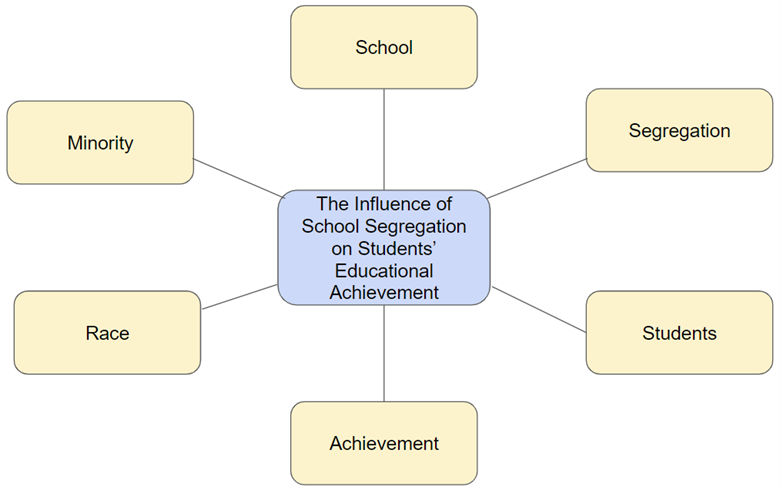
I chose this article because it discussed the effects seen today on schools segregation and provided me with many statistics to use in my journal article. The Influence of School Segregation on Students’ Educational Achievement focuses on the achievement gap that is seen between students of color and white students, hence the words achievement, school, race, students, and minority showing up the most. Achievement can be defined as a thing done successfully, typically by effort, courage, or skill. In the context of this article, achievement refers to academic achievement and the comparison between students of color and white students. This article focuses on the inequality in the U.S., but in schools specifically, so that is why the word school is mentioned frequently throughout the article. The article is about how segregation has affected students in schools, so segregation is heavily talked about. Segregation is the act of setting someone or something apart from others. Until 1954, schools were segregated so that black students could not go to school with white students. This has had a huge impact on education for students of color and white students. The article also uses the words race and minority frequently. Race is defined as a social construct that groups people based on perceived physical traits, social factors, and cultural backgrounds. Because of this social construct, an entire group of people was discriminated against and hated on for many years in America. In the article, the African American race is described as a minority, also known as a marginalized group. This means in the context of the article that they were given less opportunities than the white majority.
Worknet 2: Bibliographic
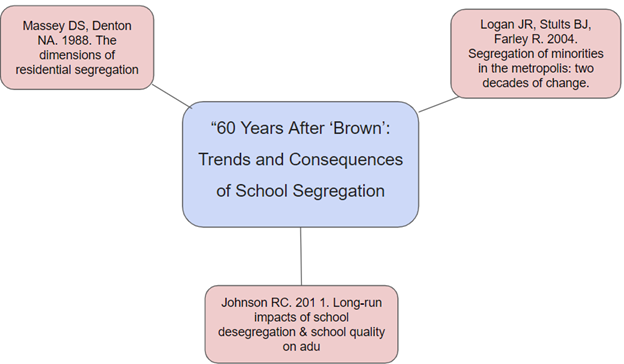
“60 Years After ‘Brown’: Trends and Consequences of School Segregation cites over 30 sources in its article. The three sources shown in the above worknet are among the most commonly cited sources of the 30 sources in the article. Johnson’s article focuses on the long-term impacts of school desegregation on adult socioeconomic statuses and health outcomes. Based on empirical evidence from a study following life trajectory from people born between 1945 and 1968, following until 2013, the data leads to the conclusion that the measures of desegregation in schools led to a decrease in class size, improving teacher to student ratios and improving educational outcomes. This provides a new perspective on the “60 Years After ‘Brown’” article because it focuses on the positive rather than the negative. Massey’s article focuses on the effects of residential segregation, specifically in metropolitan areas. The article affirms the hypothesis that there are five factors to look at when talking about residential segregation: evenness, exposure, concentration, centralization, and clustering. This article explains the “60 Years After ‘Brown’” article’s question of how desegregation has affected socioeconomic status. Logan’s article was published in the National Library of Medicine and discusses how rather than the U.S. desegregating entirely, instead it just focused its segregation on other ethnic groups and races, like Hispanics and Asians in the 1980s and 1990s. This further emphasizes the “60 Years” article’s point that segregation and its effects on the U.S. population are hard to measure. I chose this source because there was lots of credible information explaining many many studies showing the effects of school segregation on blacks today. This source provided great insight into my research question.
Worknet 3: Affinity
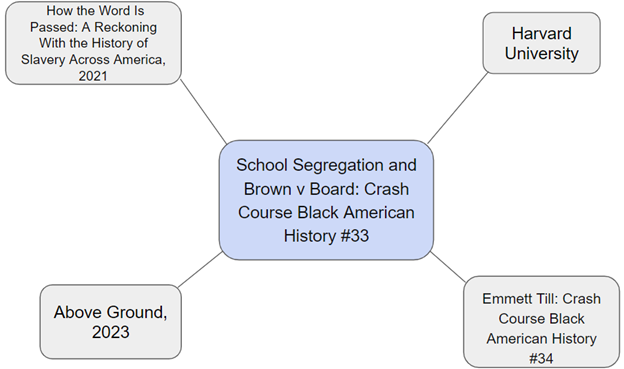
Clint Smith is the host of Crash Course’s YouTube video called School Segregation and Brown v Board: Crash Course Black American History #33. Clint Smith earned a Bachelor’s of Arts degree in English at Davidson University, and then earned a Ph.D. from Harvard in education. His work mainly focuses on African American advocacy. He published several books, his most famous including How the Word Is Passed: A Reckoning with the History of Slavery Across America and Above Ground. How the Word Is Passed tells the story of the slavery in the United States of America. The book tells about the Monticello Plantation in Virginia, where Thomas Jefferson wrote about the need for liberty while simultaneously enslaving over 400 people. The book also tells about the Whitney Plantation, one of the only former plantations preserved to show the experiences of the enslaved that worked there. How the Word Is Passed discusses the centuries of impact that slavery had on the United States. One of his other books, Above Ground, is about the complexity and challenges of fatherhood, especially relating to racial issues that he’s faced, the legacy of slavery and racism, and how they all coincide in our changing world. Finally, Clint Smith also hosted the next episode in the Crash Course series on Black American History called Emmett Till: Crash Course Black American History #34. This is the continuation of School Segregation and Brown v Board: Crash Course Black American History #33, focusing now on the story of Emmett Till, a young African American boy accused of offending a white woman who was abducted and lynched in Mississippi in 1955. All of the works that Clint has produced or published tell the story of black history in the United States. They all speak on important topics that deserve not to be skipped over when discussing history in America. Clint Smith advocates for the African American population through his work. I chose this source because it provided great background information into the history of Brown v Board of education and how it came to be. I was able to understand the history surrounding my topic much better, and from there create more research questions.
Worknet 4: Contextual
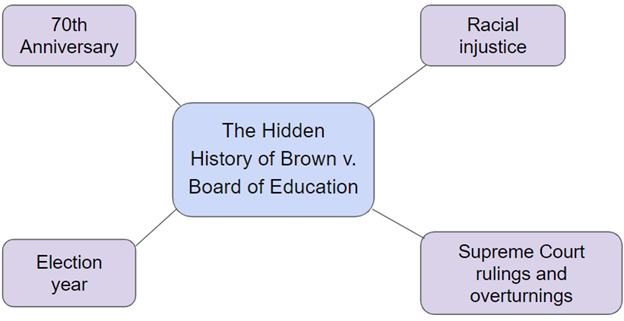
This YouTube video by NBC News was uploaded on May 31, 2024. This is the 70th Anniversary of the Supreme Court Brown vs Board of Education ruling. NBC wanted to highlight the importance and impact of Brown v. Board of Education and share new information about the case since it was the 70th Anniversary of the Supreme Court ruling. I wanted to use this source because, like the other video source, it provided depth and information surrounding the history of the monumental Supreme Court case. During this time, the Supreme Court case of Roe v Wade was overturned. This sparked huge controversy, and may have led news sources to focus on other past rulings of the Supreme Court and how the U.S. would be affected if they were overturned. During the time of this YouTube video, there is still a lot of racial injustice outrage following the events in 2020. There is a large focus, especially in the criminal justice system and police department, of racial injustice in today’s world. This could be why a news source would cover the history of Brown v Board of Education. They would want to draw attention to a significant racial change in the history of the United States. This video was also published in an election year. Since a significant portion of the U.S.’s voting population is black, calling attention to racial injustices and how certain candidates might affect these racial groups may sway these voters one way or another to vote for a certain candidate or vote against a certain candidate. All of these social and cultural factors during the time of the published video may have played a role in why and when this video was published and the significance of it.
Worknet 5: Semantic
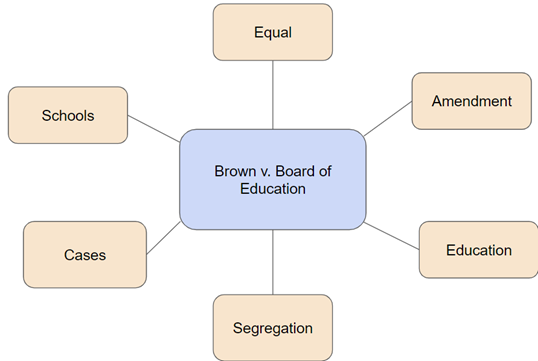
Brown v. Board of Education is an article of the summary of the Supreme Court ruling in 1954 to desegregate schools in the United States. I chose this article because it strictly provided the facts of the case and acted as a great historical document. Since it heavily discusses the court case, the word amendment appears very often in the text. An amendment is a change designed to improve a piece of text or legislation. In the case of this article, an amendment refers to the changes or additions to our constitution. The article also uses the word education frequently. Brown vs Board of Education segregated schools, which affected the education of students in America. This is why the article uses the word schools often as well. The article discusses the arguments reasoning the case of Brown v. Board, which includes the discussion of schools across America. Segregation, the action of setting someone or something apart from the others, of course is dealt with heavily in this article because of the discussion of segregation in schools. The word equal is mentioned often in the article as well. Equal is defined as being of the same value. If supposedly all men are created equal, as stated in the U.S. Constitution, yet a large portion of the U.S. population was not offered equal education, then there’s an injustice in America. This was an argument for the case of Brown v Board. Equality in education for students was and is deserved for everyone. Equality of opportunity was and is also deserved for everyone. Cases also appears a lot in the article, due to the mention of past Supreme Court cases. All of these words relate to and emphasize the main point in the article, summarizing Brown v Board of Education and how it came to be.
Worknet 6: Contextual
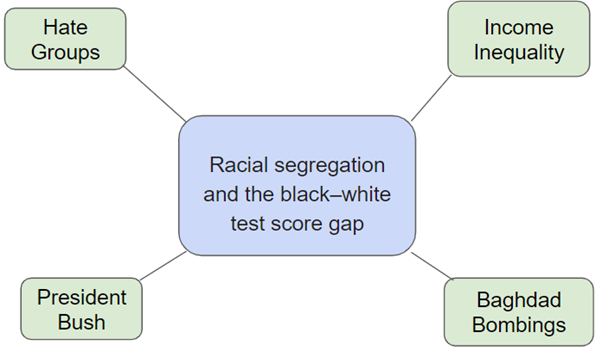
I chose this article because it went into specifics about the black-white test score gap. It provided great detail for that area of my research. “Racial segregation and the black-white test score gap” was an article published in December of 2007. 2007 was a year full of many important events. One of the most significant events was the rise in hate groups, specifically racial hate groups. The number of hate groups rose a staggering amount in 2007, rising by 48%. This is a staggering and worrying statistic. This could be why the author of this article wanted to bring awareness to racial segregation and racial injustices in education. The Baghdad bombings also happened in 2007, another horrific event. The Baghdad bombings were caused by a terrorist attack on the capital of Iraq, Baghdad. People were also upset over income inequality in 2007. Many Americans were becoming pessimistic in their opportunity for growth in America because they believed the rich were getting richer and the poor were getting poorer. This can be related to the opportunity for African-Americans as well. President Bush was also president at the time, and there were many people swaying away from Bush and looking for a blue candidate, which turned out to be our first Black president, Barack Obama. This marked huge steps for racial equality, opportunity, and representation in the United States of America. All of these important world, social, political, and cultural events may have factored into the publication of this article in 2007.
Card, D., & Rothstein, J. (2007). Racial segregation and the black–white test score gap. Journal of Public Economics, 91(11), 2158–2184. https://doi.org/10.1016/j.jpubeco.2007.03.006
Reardon, Sean F., and Ann Owens. “60 Years After ‘Brown’: Trends and Consequences of School Segregation.” Annual Review of Sociology, vol. 40, 2014, pp. 199–218. JSTOR, http://www.jstor.org/stable/43049532. Accessed 16 Sept. 2024.
Smith, Clint. School Segregation and Brown v Board: Crash Course Black American History #33. 2022. Crash Course, https://www.youtube.com/watch?v=NBlqcAEv4nk.
The Hidden History of Brown v. Board of Education. 2024. NBC News, https://www.youtube.com/watch?v=VnQYYm-2nsg.
Vivian, Lea. "The influence of school segregation on students’ educational achievement." Perspectives 9.1 (2017): 11.
https://scholars.unh.edu/perspectives/vol9/iss1/11/
Warren, Chief Justice Earl. "Brown v. board of education." United States Reports 347.1954 (1954): 483.
https://www.whatsoproudlywehail.org/wp-content/uploads/2013/01/Warren_Brown-v-Board-of-Education.pdf
I started with an outline of the main topics of my journal article. I then created claims for each topic. Then, including my research and citing my sources, I added information to prove my claims in order to make a sound argument. I found that a lot of my sources agreed on their information, so I’ve been able to synthesize my sources to create even better reasoning to back up my claims. I found trouble writing my introduction, but through careful thinking and planning, I was able to accomplish the introduction. I also received feedback from peers and my instructor to improve my introduction and improve the flow of my journal article. I want to continue adding better transitions between topics and sentences, and I also want to continue adding more research from my sources to my journal article.
12/07/2024 Revision - The peer feedback I’ve been given has helped me improve my writing and think about my intentions while writing. I’ve been able to collect more data and information that will help support my arguments, and I’ve also improved on my synthesizing skills which also makes my arguments stronger. I added overall more depth and length to my journal article, and edited my phrasing in some places to improve the fluidity of my journal article.
Introduction
Everything that has unfolded throughout the course of history has shaped the world we live in today and will continue to influence the future that we are building. Throughout the United States’s history as a country, it has withheld a system of slavery. In 1865, slavery in the United States was abolished; however, the U.S. then adopted a system of segregation. This forever impacted the country’s view of the concepts of justice and equality. When many people began to question the rationale of segregation, the government justified segregation under the reasoning that it was a ‘separate but equal’ system, but separate was inherently unequal. Eventually, in 1954, the Supreme Court case, Brown vs Board of Education, deemed school segregation to be unconstitutional. This was monumental for the U.S. because it meant that we were progressing as a country, and this was one of the events that helped to set off the Civil Rights Movement. This ruling created great advancements and opportunities for people of color in the country; however, while it's true that the Supreme Court case greatly advanced equality in the United States, the effects of long-lasting segregation are still negatively impacting people of color today. While there are positive steps and advancing measures currently taking place, such as integration techniques, desegregation plans, and efforts to provide proper funding, these efforts need to increase greatly in order to rectify the decades upon decades of setbacks and hardships African-Americans have and continue to face. School segregation and the Supreme Court case of Brown vs Board of Education have greatly impacted the education and lives of students of color in the United States.
School Segregation Impact on Student Success
The ruling of Brown vs Board of Education advanced the Civil Rights Movement and gave opportunity to students of color. The Supreme Court ruling helped to set off the Civil Rights movement. The National Association for the Advancement of Colored People, referred to as the NAACP, was formed, and in the early 1950s, they wanted to claim small victories wherever they could to advance the rights of people of color. According to the NBC News video titled The Hidden History of Brown v. Board of Education, one of the NAACP's earliest goals was to desegregate schools (News, NBC 2024). They sent people to try to enroll their black students into white schools, knowing it would anger many people, with the intent to call attention to the social injustices of the U.S. at the time so that change could be made. Many black students also protested and went on school strikes (News, NBC 2024). This intentional controversy eventually worked, creating the case of Brown v Board of Education. Initially, however, the goal of the NAACP was to create an equal education system, not necessarily integration between blacks and whites (News, NBC 2024). They felt this goal was too lofty. But when the result of the Brown v Board case ruled segregation to be inherently unequal and therefore unconstitutional, this meant that desegregation now became a reality. This huge step helped to spark the Civil Rights Movement. Blacks gained hope that change in the U.S. towards equality was possible and through proper action, legislation could change for the better for them. Brown v Board also gave opportunity to people of color by proving that action could be made through the court, and that civil change could occur in the courtroom. Clint Smith, author of the award-winning novel, How The Word is Passed, and host of the Crash Course video, School Segregation and Brown v Board: Crash Course Black American History #33, discusses the issue that Blacks in America didn’t have representation in their state, so changing laws via legislation was nearly impossible. The court system was one avenue where blacks could fight for their rights (Smith 2022). To better elaborate on this concept, it’s important to know how Brown vs Board came to be and the details that accompany this case.
In June of 1866, the 14th amendment was passed, and this amendment gave African Americans citizenship. This is important because this meant they had access to certain rights and resources in America (Smith 2022). However, whites then created Jim Crow laws that hindered African Americans from voting and implemented segregation (Smith 2022). This segregation ensured that blacks in the U.S. were not able to exercise their benefits of citizenship (Smith 2022). Those benefits of citizenship included education. The NAACP was then founded and was working towards desegregation, specifically desegregation of schools, all the way back in the 1930s when they drafted the Margold Report (Smith 2022). There was some progress with colleges and public universities, but with elementary and secondary schools, there was no forward movement (Smith 2022). This meant that black children couldn’t access a proper foundation of education, which made access to university almost irrelevant. The NAACP then compiled five cases, which took about twenty years, to support the case that the “separate but equal” method of segregation was unconstitutional (Smith 2022). These compiled cases created Brown v Board of Education, brought to the Supreme Court in 1953 (Smith 2022). The people involved in these cases often faced violent threats, lost their jobs, were chased out of their state, and risked their lives fighting for their rights (News, NBC 2024). One particular case was that of Oliver Brown, a pastor in Topeka, Kansas. Oliver Brown tried to enroll his daughter in school, but the principal wouldn’t allow it because she was black, and the school did not accept black students. Brown then became the lead plaintiff for the Supreme Court case–hence the title Brown vs Board of Education–with twelve other plaintiffs (Smith 2022). Then, on May 17, 1954, the Supreme Court unanimously decided that segregated public schools violated the Equal Protection Clause (Smith 2022). Chief Justice Warren said ‘separate institutions are inherently unequal’. The NBC news video also quoted Chief Justice Warren in his deliberation that separate is inherently unequal (News, NBC 2024). These two videos both highlight the significance of this statement. It was then made clear as to how vital it was that students of color were given the same access to primary public education because it was deemed unconstitutional for them not to receive access to the same public education. There were, however, repercussions and loopholes surrounding this monumental event. Although the ruling was a great advancement for African-Americans on paper, in reality there weren’t as many positive outcomes as people had hoped, and there were large negative effects of segregation up until that point.
Segregation in schools until 1954 drastically set students of color back academically.
Before Brown vs. Board of Education, in many areas, there was only one school for black children to go to, and it was very far away. Black parents either had to send their children to school in another county, which was not attainable or realistic for a lot of families, or not send their children to school at all (Smith 2022). The highly limited access to schools prevented the proper education of many young blacks in America. In addition to limited access, according to Clint Smith, the few black schools that did exist were horrifically underfunded and neglected (Smith 2022). The NBC News video also provides details about the neglect of the black schools, describing the overcrowding in all-black schools, the lack of heating in the winter that made the cold months unbearable, and the leaking in the ceilings that dripped water onto students’ papers (News, NBC 2024). What makes the situation even worse is that terrible conditions and negative effects did not end when segregation ended.
In the United States today, there’s still a significant black-white test score gap. David and Rothstein, in Racial segregation and the black–white test score gap, explain, ‘test scores are lower at schools with higher black enrollment shares… Likewise, there is a strong negative correlation between education outcomes and the fraction of black residents in a neighborhood’ (Card and Rothstein 2007, 1). It’s important to note that correlation does not imply causation and that there are many factors that contribute to test scores and education outcomes, but this evidence further proves that there is definitely a noticeable black-white test score gap. The higher the fraction of black residents in a given school district, perhaps the more neglected the school district, and therefore the worse the education outcomes of that school district. Lea Vivian, author of The Influence of School Segregation on Students’ Educational Achievement also finds in her studies that as school segregation among a minority group increases, the achievement gap also increases (Vivian 2017, 7). The issues of negligence in black education and under-performing test scores are still prevalent even after school segregation officially ended seventy years ago. In addition to black and white test-score gaps, there are overall significant achievement gaps in the U.S. between black and white students. Sean Reardon and Ann Owens in 60 Years After ‘Brown’: Trends and Consequences of School Segregation state that data regarding school segregation and segregation trends may be difficult to collect because there are various, nuanced ways to measure segregation (Reardon and Owens 2014, 200). However, there is no denying that there are segregation trends, and that there are significant achievement gaps between black and white students across the United States. One way to measure academic achievement in high school is to examine the ‘tracking’ of students. Tracking refers to which courses students are placed in, like whether they’re taking AP classes or not (Vivian 2017, 8). Across schools in the U.S., even in diverse ones, there are much fewer students of color on high-track classes, such as AP classes, and the low-track classes-wherein a majority of students of color reside-result in much lower achievement (Vivian 2017, 8). These measurements prove a clear trend of academic setback in black students. Another study found that in Riverview High School, a desegregated high school, black students make up about 40% of the student body, but only 9% of blacks are enrolled in AP Calculus. Meanwhile, whites make up around 50% of the student body, and 82% of them take AP Calculus (Vivian 2017, 8). This study shows that even in desegregated, suburban schools, achievement gaps in the U.S. are very prevalent. Along with achievement gaps, the issue of academic inequality can be further shown in the opportunity segregation, economic segregation, and education segregation that have set students back.
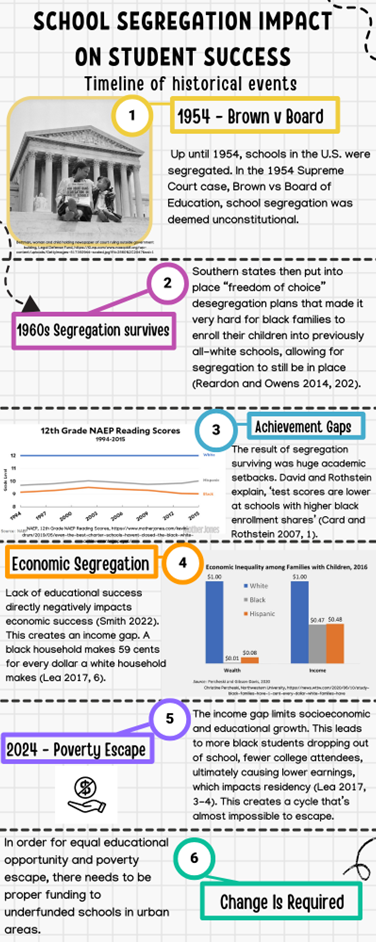
Segregation in schools until 1954 negatively impacted students of color in various aspects, not just academically. After the ruling of Brown v Board in 1954, people still found ways to segregate. This means that the problem of school segregation was not solved. After Brown v Board, most states in the South put into place “freedom of choice” desegregation plans in which schools made it very hard for black families to enroll their children into previously all-white schools, allowing for segregation to still be in place despite Supreme Court ruling (Reardon and Owens 2014, 202). In 1968, 77% of black students went to majority black schools, and 50% of black students went to schools where 90% of the student population was black (Reardon and Owens 2014, 202). These statistics show that there was essentially zero progress toward school desegregation after Brown v Board which happened in 1954. Almost all of the schools in the U.S. were still highly segregated. Lea Vivian also refers to the issue of segregation still being in place even after Brown v Board (Vivian 2017, 2). She emphasizes the point made by Reardon and Owens that schools were still able to segregate by highlighting the weak federal enforcement and the covert “freedom of choice” systems that essentially created loopholes for the continuation of segregation. NBC News found that some school districts took another approach and went so far as to shut down their entire school district so as not to have to desegregate (News, NBC 2024). Despite the Supreme Court ruling, segregation still continued to be an issue. Another variation of segregation and racism is not just where black students are enrolled in school and the classes that they take, but the attitude of the teachers towards their African American students. The aforementioned Riverview High School study found that when black students were placed in higher level classes, even though proving they belonged in those classes, their teachers had lower expectations of them (Vivian 2017, 8). Black students who were interviewed said they could tell that their teachers were not used to seeing black students being successful, which was a disheartening feeling to them (Vivian 2017, 8). This double standard and differing attitude of teachers, even in integrated schools, demonstrates the unwavering segregation present in the country’s schools in the present day. There’s an overall view of black students not being as capable as their white counterparts, which greatly harms the academic success of these black students. There is no denying that segregation was not abolished completely in schools right after Brown v Board, and this lack of proper change further contributed to the damage in education of students of color.
Since school segregation continued to be in place even after the Supreme Court ruling, black students had a very difficult time achieving educational success (as shown in the achievement and test score gaps). Educational success directly relates to and impacts economic success, so when black communities couldn’t access proper education, these communities could then not achieve economic success (Smith 2022). Segregation in schools not only affected the education of black students, it set whole communities back economically as well. The Black-White income gap in the U.S. is further evidence of the economic and opportunity disparities blacks face. A black household currently makes 59 cents for every dollar a white household makes on average (Vivian 2017, 6). This drastic income gap limits so many opportunities for people of color in instances such as properly funded education, socioeconomic growth, financial freedom, and poverty escape. Vivian goes on to state that today there is a trend of whites moving out of integrated communities, from urban to suburban areas. Blacks tend to stay in racially mixed areas in urban areas, which tend to be more inclined to less opportunity. This leads to racial and economic segregation, which leads to blacks living in more highly impoverished places. This phenomenon directly leads to more African-American students dropping out of school, which leads to fewer college attendees, ultimately causing lower earnings, which impacts residency (Vivian 2017, 3-4). This creates a cycle that is very hard to get out of, which is why these issues still exist in our country today. Along with racial segregation in schools still being in place after Brown v Board, there was and is still economic segregation. In 2005, the average black student attended a school where about 60% of the students were considered poor, while the average white student attended a school where only around 33% of the students were considered poor (Reardon and Owens 2014, 204). This statistic shows a very clear pattern of economic segregation demonstrated in schools in the United States of America. Schools in high-poverty areas tend to have significantly lower funding and fewer resources. We can define these resources as physical facilities, skilled teachers and staff, and school curriculum. A large majority of students in these high-poverty areas with lower funding and fewer resource schools tend to be black students (Reardon and Owens 2014, 204). This is another example of the modern segregation trends we see today and how economic segregation and education segregations are directly correlated and related to one another. Further evidence from Reardon and Owens study regarding wealth and academic success also support the idea that economic and education segregations are correlated. Reardon and Owens find that poor students-a majority of which are black-have less exposure to high-achieving classmates due to the relationship between parental income and school enrollment (Reardon and Owens 2014, 208). With less exposure to more successful students, these poor students then have a much more difficult time achieving the academic success that the high-income students do. When students don’t see success around them, it’s hard for themselves to find success. With clear-cut examples and studies showing the existence of segregation in schools today, as well as economic segregation, it’s very difficult to deny that these issues are present. With state governments still finding ways to segregate even after school segregation was made unconstitutional, clear evidence showing residential trends of people of color compared to whites and the relationship between residence and education and opportunities, and the achievement, test score, and income gap between blacks and whites, it’s clear to see the negative impact that the long system of segregation still has on our country today. It’s important to remember that these racial, civil, social, and educational issues are still problems that need to be dealt with today and that these issues need to be addressed.
Change is required in order to create a system of equal education in America. The U.S. federal government cannot continue to support this system that makes equal education almost unattainable for such a vast population of our country. Citizens of the U.S. cannot continue to live under these conditions. Closing achievement gaps is necessary in the United States. Studies from the article Racial segregation and the black–white test score gap show that moving from a segregated city to an integrated city correlates to a 45-point closing of the black-white SAT test score gap (Card and Rothstein 2007, 3). Studies also show that the more integrated the school, the smaller the white-minority achievement gap is in that school (Vivian 2017, 7). This positive change needs to be a possibility for all so that everyone has the opportunity to better their lives. Studies also find that desegregation in the 1970s led to a 2 to 3 point decrease in the rate of black students dropping out of high school (Reardon and Owens 2014, 210). Reardon and Owens elaborate and state that the graduation rate for black students then increased by about 1%, and in addition, they find that the desegregation does not have effect on whites (Reardon and Owens 2014, 211). This means that desegregation greatly benefits blacks and has no harmful effect on whites, which aligns with Card and Rothstein’s studies. There is also evidence showing that desegregation may increase the expectations of teachers for black students (Reardon and Owens 2014, 212). This addresses the inequality issue of teachers having lower standards and therefore accepting lower academic quality, decreasing academic education. This further proves that the equal opportunity provided by desegregation is necessary for all. In order for this equal opportunity, there needs to be proper funding. Funding to segregated or previously very segregated schools is necessary. Currently, white families are more likely to be able to move to suburban areas where there are more highly funded schools, while most black families reside in areas with underfunded schools, which cause lower educational achievements (Vivian 2017, 6). There has to be an effort to focus on underfunded schools so as to provide equal primary education for all, regardless of social class, economic status, or residential status. Failing to make this change would be an act of segregation itself.
Brown vs Board of Education and school segregation have had an immense impact on the education of students of color in the United States. Until 1954, schools in the United States were segregated. This meant that students of color could not attend school with the white student population. Since the white schools were the ones with proper funding and resources, this led to better education for white students and poor education for black students because there was a lack of funding for the all-black schools. In 1954, when the Supreme Court ruled school segregation to be unconstitutional, America took a step in the right direction towards equality, and the Civil Rights Movement began. Blacks in the U.S. gained opportunities that they did not have previously; however, the long-lasting lack of equal education in America led to achievement and test score gaps, and even though school segregation was declared unconstitutional in 1954, these gaps in achievement and test scores are still prevalent to this day. These achievement gaps affect people of color in other aspects of life other than education as well, such as opportunity, financial, and economic aspects. Change in the United States is required in order to create a system of equal education and equality overall. While it is true that the desegregation of schools has greatly advanced our nation and given educational opportunities to students of color, it is simply not enough. The effects of long-lasting segregation have caused issues that desegregation alone could not solve. The United States requires proper action through proper funding to boost the efforts towards desegregation, equal opportunity, and equality. There are efforts being made and studies being conducted that are trying to bring to justice these inequalities and rectify the situation for blacks in this country; however, these efforts need to be heightened and treated with greater intensity in order to bring true equality for all.
Bibliography
Card, David, and Jesse Rothstein. 2007. “Racial segregation and the black–white test score gap.” Journal of Public Economics 91, no. 11-12 (December): 2158. https://www.sciencedirect.com/science/article/pii/S0047272707000503?via%3Dihub.
Johnson, Rucker C. 2015. “Long-run Impacts of School Desegregation and & School Quality on Adult Attainments.” National Bureau of Economic Research, (August).
Lea, Vivian. 2017. “The Influence of School Segregation on Students’ Educational Achievement.” University of New Hampshire Scholars Repository 9, no. 11 (August).
News, NBC. 2024. “The Hidden History of Brown v. Board of Education.” NBC News. https://www.youtube.com/watch?v=VnQYYm-2nsg.
Reardon, Sean F., and Ann Owens. 2014. “60 Years After "Brown": Trends and Consequences of School Segregation.” Annual Review of Sociology 40:20.
Smith, Clint. 2022. “School Segregation and Brown v Board: Crash Course Black American History #33.” Crash Course. https://www.youtube.com/watch?v=NBlqcAEv4nk.
Warren, Chief Justice Earl. 1954. “Brown v. board of education.” United States Reports. https://www.whatsoproudlywehail.org/wp-content/uploads/2013/01/Warren_Brown-v-Board-of-Education.pdf.
I started with finding the template that best fit my topic. Since my topic included the history and effects of school segregation, I thought a linear timeline-like template would be the best. I then condensed my information into main points with statistics. I then added graphics and pictures where it was appropriate to give visuals to my points or statistics. I spent the most time on spacing and formatting. This was the biggest struggle for me because it was very hard to get the pictures to be big enough to read while also fitting onto the page. I found zooming in and then scrolling from the top to the bottom was the best way to read it. Feel free to zoom in to read the pictures. I’m hoping to receive feedback on how I can improve the spacing and information so that it’s easier to read, or if it’s fine to just zoom in to read it.
In the next section, you will see three sample portfolios from previous UN 1015 students. There are different ways to read this:
At the beginning of the course, skim each of the portfolios to see how the assignment sequence works and what the final product you are working toward will look like. This can give you a sense of how each of the tasks you complete will work together.
As you proceed through the course, review all three examples of the primary core assignments/writing projects as you approach your own. How do each of the three students take similar or different approaches to the writing task? What strengths do they each have? What techniques might you use?
At the end of the course, review the complete portfolios for examples and ideas about how the writers have assembled their portfolio, reflected on their learning and documented their self-assessments through metacognitive writing.