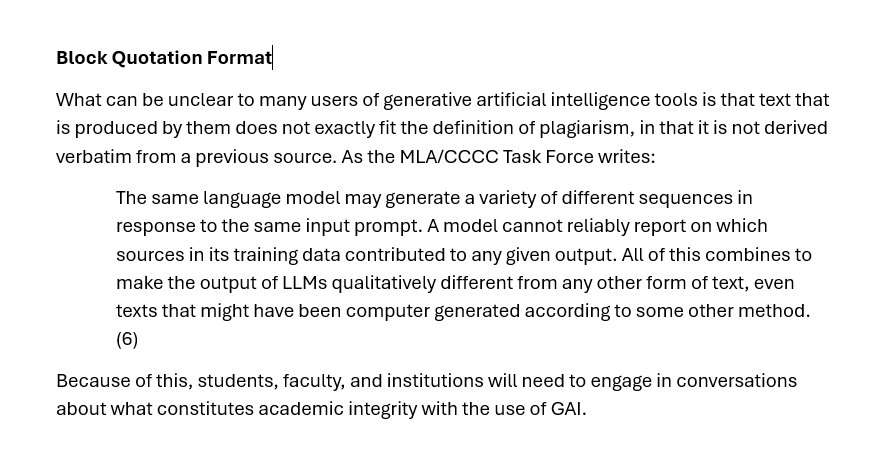
Figure 1: Example of a block quotation.
In previous chapters, you have read about and practiced how to focus your search for information and how to write from and about sources. This chapter goes into more depth about strategies for using sources for different purposes in different types of writing. For UN 1015, you'll be using sources in a variety of ways: to provide context for claims, to support an assertion, to illustrate a point, to elaborate on a distinct perspective. You might also be analyzing sources for how they are structured and the effects of their textual choices. It's important to know that academic disciplines use sources differently, so the work we do in this area in 1015 will be a foundation for subsequent projects in your future college courses--but that you'll continue to build discipline-specific knowledge in the future.
Certainly, some of the content will be familiar to you from prior courses where you have practiced research and writing skills, and that will be a valuable foundation to build on as you encounter new genres, writing tasks and discipline-specific projects.
Any time you incorporate an information source (e.g., secondary sources, primary research, research results from an experiment, etc.), there should be a goal to using that particular source. Those goals will be related to a variety of contexts. As you write, consider:
Questions to ask yourself as a writer when approaching source use:
Integrating sources is how we provide evidence in our writing. It contributes to ethos in a piece of writing because it shows that you, as a writer, have done your research and you are writing from an informed position. In academic writing specifically, integrating sources is good practice because it provides a research roadmap for future scholars. Providing the sources where you gathered information from allows the larger academic community to share in the knowledge discovery process. There are three main ways to integrate a source for traditional academic purposes: quoting, paraphrasing, and summarizing.
Quoting involves stating an author’s work exactly as it appears in the original text and providing an in-text citation for the source material. Quotations serve a few major purposes. First, they add to the credibility of your writing. Citing prominent scholars in your field demonstrates that you are engaging in a conversation with them, and shows that you know your stuff. Second, quotations allow you to call attention to a point you want to agree or disagree with. This could be due to the eloquent way the source’s author wrote, or conversely, it can be used to critique the author’s word choice, style, etc. Third, quotes can be used to demonstrate multiple points of view on the same subject, which, once again, shows that you are engaging in a scholarly conversation.
In this section, we demonstrate how quoting, paraphrasing, and summarizing serve different functions, using this paragraph from the Modern Language Association/Conference on College Composition and Communication’s Task Force on Artificial Intelligence and Writing Working Paper #1.
“LLMs work by using statistics and probability to predict what the next character (i.e., letter, punctuation mark, even a blank space) is likely to be in an ongoing sequence, thereby 'spelling' words, phrases, and entire sentences and paragraphs. It is not unlike autocomplete, but more powerful. LLMs are trained on vast bodies of preexisting text (such as content from the Internet), which, to some extent, predetermine their output. All of the text a model generates is original in the sense that it represents combinations of letters and words that generally have no exact match in the training documents, yet the content is also unoriginal in that it is determined by patterns in its training data. The same language model may generate a variety of different sequences in response to the same input prompt. A model cannot reliably report on which sources in its training data contributed to any given output. All of this combines to make the output of LLMs qualitatively different from any other form of text, even texts that might have been computer generated according to some other method. It should be noted that given the assortment of software applications drawing on LLMs, presenting them through different user interfaces to offer various affordances, they are also unavoidable.” (6)
Quoting means you are taking information from another source and using their wording exactly. Quotation marks communicate to readers that the text that you are including is exactly the same as the original, and should be used in the case that you are including four words or more exactly as they are in the original material. Quotations should be used sparingly, such as when you are
Because this work is not yours, quotations must be introduced through a signal phrase that indicates a quotation. Signal phrases include:
These types of signal phrases tell the reader you are quoting information but do not indicate any feelings toward the quotation or speaker in the quote. Including “Author” or “Dr.” in the signal phrase also signals the ethos of the person you are quoting.
Quotations imply that you are using the speaker’s words directly—this means you should not change the phrasing of the quote. If needed, you can shorten a quote by using ellipses. For example:
"As the MLA/CCCC Working Paper notes, 'The same language model may generate a variety of different sequences in response to the same input prompt [but] ….cannot reliably report on which sources in its training data contributed to any given output'” (6).
Notice how this does not change the speaker’s intended meaning. If you use an ellipsis in your quote, be sure that it does not change the speaker’s meaning.
When using a quotation, it’s important to explain the quote’s presence. Never assume the audience will understand why you chose a specific source. Instead, consider using the ICE method (Introduce, Cite, Explain) to integrate your quotes. Begin by Introducing the quote’s source, author, and/or context. Next, Cite where you obtained the information from. Finally, and most importantly, Explain why you are using the quote: Does it back up a claim you just made? Does it offer an example of your claim? Does it offer an opinion contradictory to your claim? Explaining in detail allows you to situate the quote in relation to your own thoughts, and can in turn be used to enhance your argument.
The ICE method isn’t the only one available for quote integration. Find the method that works best for you.
When utilizing a quote, you have several tools at your disposal, including brackets, ellipses, and [sic]. Brackets can be used to insert clarifying words/phrases into a quote so that it flows well with your words. Ellipses can be used to shorten a larger quote into two shorter segments. [sic], or [sic erat scriptum], is a Latin phrase that means “thus was it written.” [sic] is used to convey that an error, specific word, or formatting choice that appears in a quote has been transcribed exactly as it appears.
Examples:
Using these tools can help you integrate quotes into your writing, but they should be used responsibly. In combination, brackets and ellipses can be used to obscure the original author’s meaning. It is important when using a quote to not misrepresent the context in which it was written. After all, you don't want another author to misrepresent your ideas!
If you are using a longer quotation, you may need to use a block quotation. In MLA, the standard is four lines of prose or longer. APA style requires block quotes to be used for quotes of 40 or more words. In these two styles, block quotes will be styled like this:
Figure 1: Example of a block quotation.
However, other styles (like Chicago, IEEE, or AMA) might have different rules—check your style guide to ensure you are styling quotes appropriately.
As a writer using quotations, it is your responsibility to represent the speaker’s words correctly. It is harmful to your ethos and to your readers to pick quotations without fully understanding how the speaker intends them or by intentionally picking quotes that seem like they support your ideas when they are taken out of context.
Lastly, as writers, it is important to avoid over-quoting. Using too many quotation marks can make it seem like you do not actually understand the information you are sharing and are just regurgitating information. It can imply that you do not know enough about the source material to add your own thoughts.
It’s also important to note that a first draft of a text that is source-based will likely be heavy on quoted material, as that is often a critical part of developing your document and sketching out your organization and supporting ideas. The key here is to make sure that this kind of draft (a first draft) is not the last draft, and that revision can focus on carefully considering where and how quoted material is best used for the purpose, audience, and genre. There are instances where quoting the source material directly is important, like in a literary analysis. However, when it comes to other types of writing, you want your voice to be guiding the use of information.
Paraphrasing means you are using thoughts or ideas from someone else, but putting them in your own words. In order to paraphrase, writers must do more than change a few words in the sentence. It should be your own interpretation of the source material.
To successfully paraphrase, writers can take the following steps:
Look at these two examples:
Original: LLMs work by using statistics and probability to predict what the next character (i.e., letter, punctuation mark, even a blank space) is likely to be in an ongoing sequence, thereby “spelling” words, phrases, and entire sentences and paragraphs. It is not unlike autocomplete, but more powerful. LLMs are trained on vast bodies of preexisting text (such as content from the Internet), which, to some extent, predetermine their output.
Paraphrase: The working paper explains that Generative Artificial Intelligence programs like LLM’s (large language models) are like a more robust version of "auto-complete" or predictive text, drawing from large sets of data to predict what characters will be statistically likely to occur next in a sequence.
Note that paraphrases can be as long as the original, whereas summaries tend to be shorter.
Paraphrasing involves taking a passage from a source and putting it into your own words. When paraphrasing, it is important to change the passage enough that you are not quoting without the quotation marks. Break a passage down to its component parts to identify 1) what the passage is communicating, 2) who the information is being communicated to, and 3) why you are paraphrasing the source.
You should paraphrase a source when you want to use approximately the same length and level of detail as the source material. As stated previously, you must be careful when paraphrasing to not take a quote and use a thesaurus to change some of the words. This is a form of plagiarism. Instead, write your paraphrases from scratch to ensure they are your own words.
Summarizing typically means that you are summing up the idea of the whole piece, or summing up the ideas in a section or chapter of a piece of writing—you are capturing the main ideas. You may want to summarize when you need to condense or simplify the material. Sometimes, it is not important that you get to every detail of a source. Instead, you can use it to show your understanding of the field. For example, here is an original section from the White Paper:
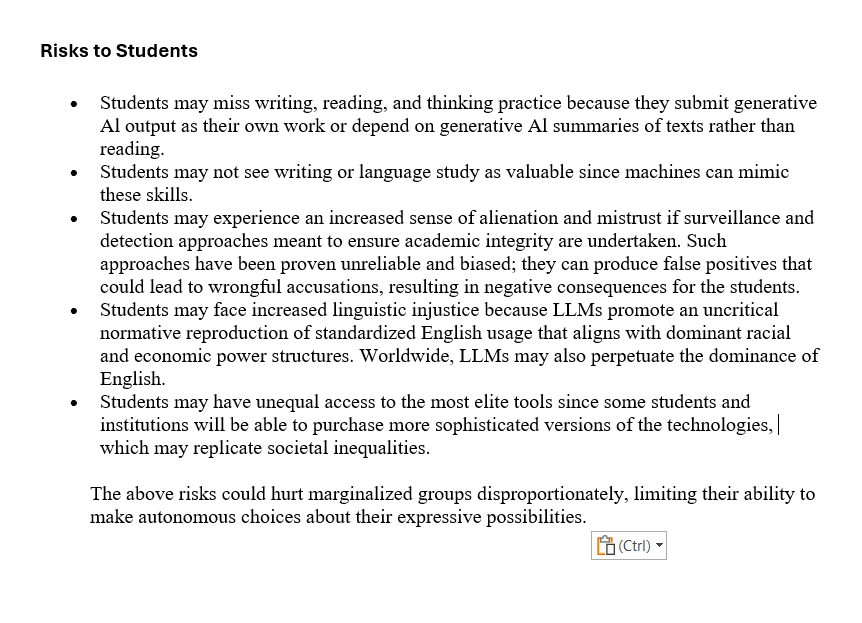
Figure 2: A section of the MLA/CCCC White Paper summarizing the risks to students of over-using GAI tools.
A summary is generally much briefer and would identify key ideas across the multiple bullets:
Working Paper #1 by the MLA/CCCC Task Force identifies a number of possible risks to education resulting from the increase in LLMs and GAI tools, including missing opportunities to develop critical literacy skills, devaluing of literacy skills, cynicism about education, increase in language bias, and increase in inequities.
A key consideration here is that decisions about how to use sources—whether through quoting, paraphrasing, or summarizing—should be made by the writer with consideration to context and purpose as well as sensitivity to reader needs and writer’s purpose.
Summaries are useful when you want to condense a large piece of text into a shorter form. Summaries can be used for background information and to summarize salient points and examples without needing to go into great detail. Similar to paraphrases, make sure that your summaries are written from scratch to avoid plagiarism.
When summarizing, you paraphrase a source but in a condensed format. Usually, summaries cover a broader range of information than a paraphrase. No matter which option you choose, an in-text citation is needed for the source material.
Some self-assessment questions to ask yourself as you are selecting how to use sources:
Though it can seem like the process of critical reading that you use as you interact with texts is entirely mental and therefore invisible, there are actually a lot of ways that writers "show" and make visible their critical reading in their own writing. There are rhetorical moves (or the things that writers do in their writing) to demonstrate your proficiency as a critical reader. You can also watch for these moves in the sources you read as part of your college research and writing career.
Critical reading and critical writing are deeply interconnected processes. With many academic writing tasks, as well as some of the writing you might do for personal purposes (to engage with readers online or in public contexts), or for work, you'll need to show that you are not only writing persuasively or competently, but that you have "done your homework" to engage with perspectives and information outside of yourself. Use the seven strategies below to critically interact with your sources.
You can demonstrate your critical reading of sources by using linking statements between your own prose and the quotes or paraphrases that you have selected. For example, if you were writing a commentary, you might connect a piece of quoted supporting evidence by writing:
Critical readers and writers are able to explain the background and qualifications of the quoted sources that they have used. This helps readers understand how and why you have selected a particular source as a supporting example or piece of evidence, as well as why the quoted material is to be trusted on your topic.
You might include a signal phrase like:
These signal phrases provide context for readers to understand why the information is relevant and useful.
In a text you are writing, you can directly explain to readers why a source is credible or useful, for example, by writing:
These short commentaries are a compact way to signal to readers that you understand the value of the information you are using.
It's possible to integrate texts in ways where you provide what's called a "qualified" use. For example, you might be persuaded that a writer offers a particularly forceful perspective on a topic, but it isn't considered an objective source. In such cases, you would strengthen your own text by acknowledging the source’s limitations.
For example:
Such framing shows that you, as a writer, are aware of the stance and genre of the author without suggesting you believe they are a neutral source of facts or information.
Critical readers can also show their understanding of a writer's purpose by showing how sources relate to it, either in support or in contrast.
An example of this would be to acknowledge a connection but with a difference:
In some types of academic or public writing, you might need to directly respond to or interpret an argument provided by a source that you are using. In a commentary or position paper, you can show your critical reading of texts by unpacking the evidence or line of thinking used in the source, and linking it to your own perspective.
For example, you could agree with part of a position but not all of it, or embrace a view provided by a source you have gathered while still acknowledging its limitations:
Another way to demonstrate your understanding of texts, writers’ positions, and the issue you are writing about is by identifying relationships between and across them.
Rhetorical moves that show your critical reading might look like this:
Sample Synthesis: As seen in the example below, the authors of “Generative AI and Policy Development” cite four different sources parenthetically with a mix of paraphrase and summary in MLA style. Parenthetical citations are emphasized in red for illustration purposes.
Likewise, faculty members must examine their own implicit biases and assumptions about the relationship between language and identity, taking care to avoid making negative assumptions about marginalized writers on the basis of academic writing. Literature across a number of disciplines has shown that international students and multilingual students who are writing in English are more likely to be accused of GAl-related academic misconduct (Tzanni, Foltýnek et al.; Weber-Wulff et al.). The problem is twofold. Studies have shown that GAI detectors are more likely to flag English prose written by nonnative speakers (Liang et al; Weber-Wulff et al.), but even faculty members who do not use Al detectors should be aware that suspicions of misuse of GAl are often due to complex factors, including culture, context, and unconscious "native-speakerism" rather than actual misconduct (Tzanni).
A citation is an important component of your writing that signifies that the information you are presenting came from somewhere/someone else. Citations typically have two components: an in-text marker, and a separate space (sometimes a full page after the end of the text, sometimes endnote or footnotes) that provide complete information about the source so that readers can consult the original if they want and to provide documentation of the information.
In-text citations might be one of two types:
There are many reasons why it is important to cite your sources. In this chapter, we are going to focus on plagiarism, ethos, and research maps.
The University of Oxford defines plagiarism as, “Presenting work or ideas from another source as your own, with or without consent of the original author, by incorporating it into your work without full acknowledgement." It is important to give the original author credit when using their ideas, and failing to do so can have severe consequences. Most universities and workplaces have rules regarding plagiarism, and it is important to educate yourself on your school’s/job’s rules. Plagiarism often occurs accidentally, but intent is irrelevant. A common plagiarism scenario students find themselves in is reusing work from a previous class. Even though you were the author, using old work for a new class serves to achieve the course’s learning goals in a dishonest manner. As odd as it sounds, you can plagiarize yourself.
Another important aspect of citations is author credibility. You may have seen news stories in the past about prominent researchers who have been caught passing off someone else’s work as their own or failing to cite their sources properly. Ethos and plagiarism go hand in hand. An author who is discovered to have plagiarized loses credibility, which can call into question all of their other work.
Outside of rules and ethics, citing your sources is a good practice because it provides a research roadmap for future scholars. Providing the sources where you gathered information from allows the larger academic community to share in the knowledge discovery process.
There are a number of available tools to help generate, create, and integrate citations into your documents. Some of the mots commonly used tools are the following. Your instructor will review some options in class.
Even with all of the online citation generators out there, it’s important to be able to identify the components of a citation. The generators aren’t perfect, and you should always double check a citation created by an online generator.
The components you’ll need to build your citation will differ depending on your citation style. See the next section about specific requirements for some common citation styles. Despite this, there are some common citation components that most citation styles share (detailed below). They include, but are not limited to:
If you are using a source that is missing a lot of the above information, it may not be reputable. Proceed with caution, and ask yourself if you can find similar—or the same—information from a more reputable source.
The author of a source is the writer, speaker, or creator of the content. Authors can be individuals, groups, or organizations.
When there is more than one author, the source will always list the authors in the order that they should appear in a citation or bibliography. For sources with three or more authors, it is common to use “et al.” (Latin for “and others”) in a citation rather than list all of the authors. In these instances, your citation should include the primary author’s name (the first author listed) and then “et al.”
A source’s title will be formatted depending on the citation style. Some styles, such as APA, ask writers to only capitalize the first word in each title and subtitle. Others, like MLA, ask you to capitalize the first word, the last word, and all other principal parts of speech such as nouns, adjectives, pronouns, verbs, and adverbs. Consult your chosen citation style’s style guide for information on how to capitalize the source title.
When accessing information from the Internet, the source will often be contained within a larger collection, journal, database or website. Similar to how a streaming service gives you access to certain shows, online containers give readers access to information that they didn’t create.
It is important to note the difference between the container and the publisher.
A source’s publisher is the organization that produced the source. A publisher can be many things, including a film production company, a book publisher, or a company that designed a website. Depending on the type of organization that published the source, the author may or may not work for the publisher.
Some sources such as books can undergo revisions and be republished with updated information. In your citation, it is important to identify which version of a source you are referencing. The International Standard Book Number or ISBN is often used to differentiate between multiple versions of a source.
For serialized publications such as journals, the volume and issue number denote when your source was published. The volume number refers to the number of years that the publication has been in production for. The issue number refers to the number of times a publication has been produced during a year.
Uniform Resource Locators (URLs) and Digital Object Identifiers (DOIs) are two methods for providing a direct link to an online source in your citation. URLs and DOIs both link to the source’s location on the Internet. The advantage of DOIs is that they provide a persistent link, whereas URLs may expire over time. For all online sources, list either the URL or DOI in your citation. If a source provides both, list the DOI, as it is a permanent link.
This is not a comprehensive list of all the citation styles available for you to use. In fact, many professional organizations have a unique style. If your citation style is not listed in this section, it is recommended that you read the author/submission guidelines for your target publication.
Citation styles are often dictated by the discipline or genre that you are writing in. Specific publications such as a journal will often specify which citation style authors should use. If unspecified, use the citation style that most closely correlates with your writing topic.
Note: In the section below, “#” refers to the source’s page number.
Chapter 7: Using Sources