With easy access to the internet and social media, most people encounter, use, and evaluate information constantly during their day. As such, many of us have tricks and strategies for determining what sites, which influencers, and which posts we trust over others. However, have you ever stopped to ask yourself what criteria you are actually using to make these judgements? Do those criteria change in different situations?
Evaluating sources for use in academic writing can leverage some of the same skills we use day to day. However, we can build on those skills with tricks and habits of mind in order to become much more informed and effective users of quality information.
In general, academic writers evaluate their sources at multiple points during their research, often for different reasons each time. Some of the broad evaluative questions they may ask include:
Most researchers perform an initial assessment of a resource they’ve selected even before reading the entire source. As you do this, it’s vital to keep in mind that there may not be one article that covers your exact topic; instead, you may need to draw data and conclusions from multiple articles in order to make your intended point or answer your research question. This is the nature—and fun!—of academic research.
For example, you are working on a research paper about the impact of specific car manufacturers on American culture. While you are able to easily find information about the history of the manufacturer to use as background information, you still need articles about the impact on society, culture, or historical significance to fill in the rest of your paper. This may require searching in a number of databases that do not focus on the automotive industry to have a better understanding of the effect that particular automobile manufacturer had in America. Don’t label articles as off-topic just because they only cover a piece of what you need.
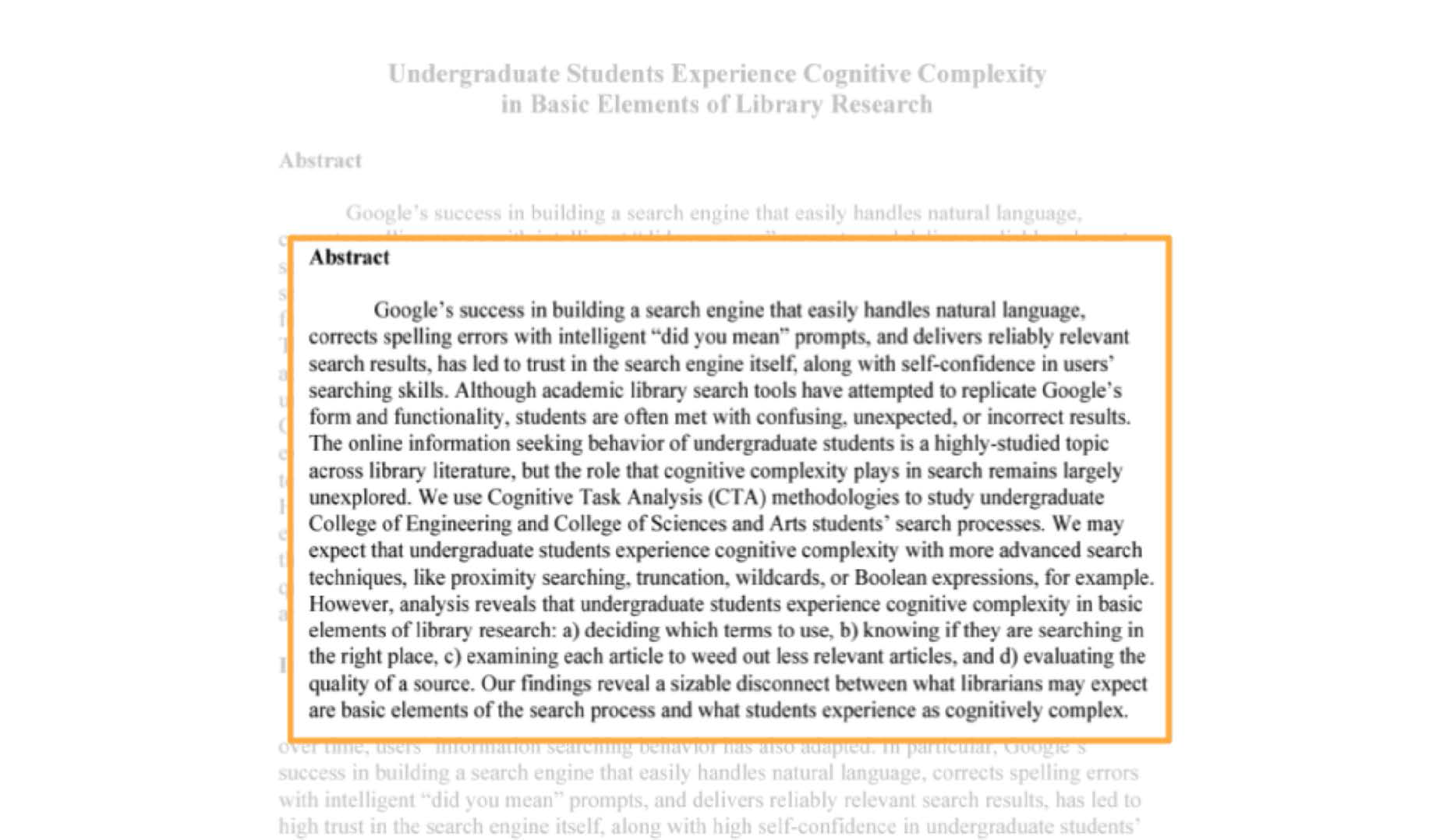
There are different strategies for an initial assessment depending on the type of source you’re looking at. Most academic journal articles have either an abstract or summary outlining the key points of the article that you can read to make an initial determination on whether the article is relevant (Figure 1). For a source where no abstract or summary is available, read the introduction and look through the headings and subheadings in the article to develop a sense of the main ideas. Newspaper articles are traditionally written with broad, important key information first, then move on to more detailed information as the article continues. Other source types can be trickier as they often don’t follow any standard conventions, but keep these same strategies in mind and leverage them when you can.
Figure 1: An image of a scholarly journal article abstract.
After performing your initial assessment, if the source doesn’t seem to be related, then it’s okay to move on. However, if it does seem to be related, bookmark it in some way to come back and do a more thorough assessment after you’ve gathered a number of relevant sources. Additionally, take note of any keywords or phrases that might be helpful in searching for more information. Oftentimes, journals will have keywords listed in the same area as the abstract. Alternatively, the authors of the article may use jargon and phrases for your topic that are new to you. This is particularly common when you are searching for technical research; the language used in academic papers is not the same language you would use to chat about a topic. For example, you may have typed “escalator design” into a tool and found that the term “people mover” is more common in research. Use these new keywords to revise and expand your search, bringing forward information you would have otherwise missed.
As you move through your search and initial assessment, check in with yourself regularly to ask:
Credibility can be tricky to assess in part because the context of your information need can impact how you evaluate a source. We’ll cover that in more depth below. However, during your initial assessment of a source, just keep an eye out for obvious instances of misinformation (when a source has wrong information) and disinformation (when a source is trying to trick or mislead a reader) (Cooke). What are some clues that a source might fall into either of these categories?
Avoid these common pitfalls during your initial evaluation of credibility:
Again, these are strategies to use for your initial assessment of a source. In an ideal world, there would be a few simple rules to follow that would indicate without a doubt that a source is legitimate. Unfortunately, due to the variation of research needs, types of information, formats, and more this isn’t possible. After you’ve gathered a number of relevant, decent-looking sources, you will need to evaluate each in-depth to determine its credibility.
Once you’ve determined that a source may be useful for your writing, it’s time to evaluate it more deeply. Your goal in this process is to select and use information with full consideration of its context, limitations, and credibility. There are many strategies for doing this, and you may have been introduced to some of them in a previous class or project. Here, we are going to focus on lateral reading. Lateral reading is a strategy borrowed and modified from professional fact checkers to determine the legitimacy and credibility of sources. Lateral reading requires you to move outside of the source and begin looking at other sources to judge legitimacy. In contrast, focusing your attention entirely on elements contained within the document you’re evaluating, such as the formatting, date, author’s name, etc, is called vertical reading (Caulfield).
In 2017, a Stanford University research group conducted a study to compare these strategies. They gathered a group of professional fact checkers, PhD. educated historians, and Stanford undergraduate students and asked each group to navigate to and evaluate social and political websites. They observed that the historians tended to employ vertical reading strategies, which often work better when dealing with vetted academic sources, and ultimately resulted in them being tricked by superficial elements of the website. Meanwhile, fact checkers left the website—reading laterally—to evaluate the information presented in the site. The study showed that the lateral reading strategy used by the fact checkers was more effective in assessing the information on the websites than the vertical reading methods employed by the historians (Wineburg and McGrew).
Vertical reading can be a good first step, and you’ll notice that many of the credibility checking strategies listed in the last section fall into this category. However, because researchers are staying within the document and basing assessment of the information on cues that are either surface level or easily manipulated, they may miss information such as editing and peer review processes, intention of the article, potential biases in references included in the piece, expertise of the author(s), and much more.
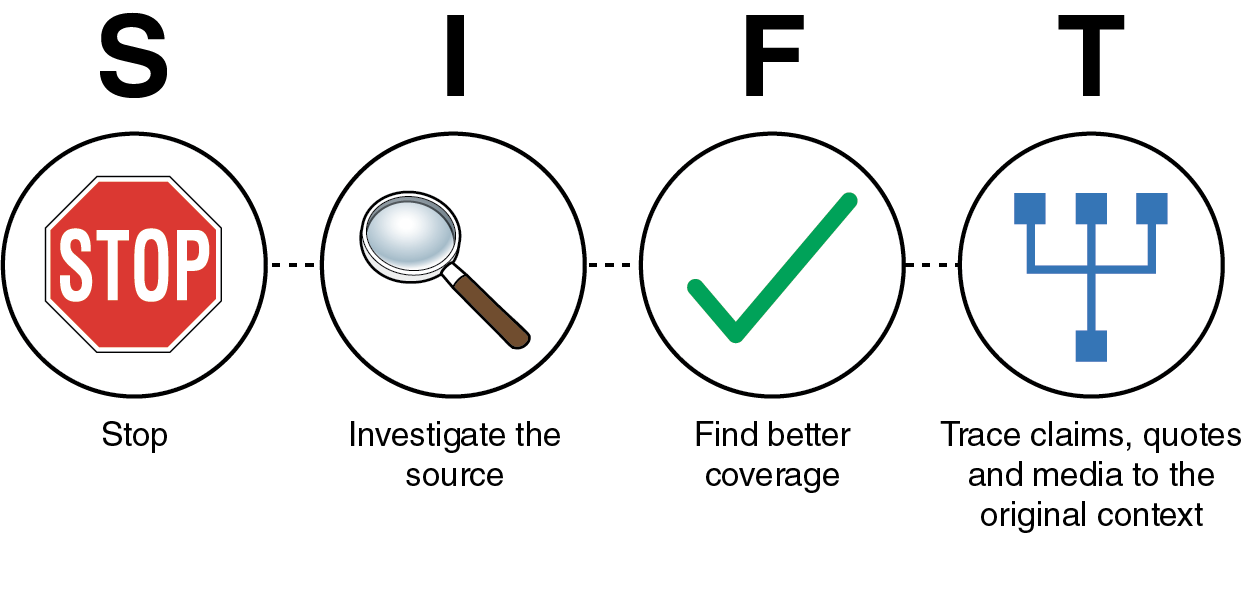
One strategy for evaluating credibility in-depth that leverages lateral reading is known as SIFT, which stands for Stop, Investigate the source, Find better coverage, and Trace the claims (“SIFT (The Four Moves)”). This method is currently what students at Tech are encouraged to consider, so we’ll walk through those steps below (Figure 2).
Figure 2: A graphic illustrating the SIFT method.
When we find a source of information, we make a snap judgment about that source. We may find ourselves drawn to the branding, colors on the website, or noticing how the content is written. Oftentimes, we think that a source of information seems legitimate based on quick observations. One of the best things you can do when considering the credibility of a source is just to stop for a moment. Ask yourself:
That last question can be tricky for new researchers as you may not know yet exactly what should be in a white paper compared to what should be in a technical report! However, this is important. Consider a news article; you would expect it to outline key events, descriptions of the people and places referenced, and possibly quotes from those involved. But if it also includes a section about the author’s feelings on a topic, this would be unexpected and an indication you may be looking at an opinion piece, or editorial, rather than a straightforward news piece. This is a signal to move to the next steps of SIFT. Additionally, don’t hesitate to ask for advice from your instructor or a librarian when evaluating a source. The information in Chapter 3: Genre Awareness can be very valuable here as well.
The primary takeaway in the Stop section is that snap judgements based on superficial elements can be easily mimicked; be careful not to fall for a nice-looking website that “looks legit”!
Before you dive any further into the source, learn about the source. You want to know:
There are lots of ways to answer these questions, and all of them require you to open more tabs on your browser! Again, lateral reading is characterized by getting outside of the original source.
When investigating who produced a source, a quick search of the publisher and author using your favorite search engine or even a tool like Wikipedia can be a good way to start. This will often bring to light the goals of the organization or publisher, the expertise of the author, and any recent controversies or biases to be aware of. If you know a source on the importance of space exploration was written by a NASA scientist, you would consider the information contained differently than if it was written by a think tank whose stated goal was to reduce government funding.
Again, keep in mind both your needs and what type of source you’re looking at. You would expect the author of a book to be an expert on the topic. However, it’s common for authors of more general sources that may synthesize other information, such as magazine articles or news, to be experienced writers instead. Given these differences, how a source is reviewed or edited is an important consideration. The review and editing processes not only catch obvious errors in grammar and spelling, but also demonstrate credibility and accuracy. The editing or reviewing process will depend on the type of source. Research articles in academic journals are typically peer reviewed.
In the context of academic writing, peer review isn’t the same as sharing your article with a friend in class for feedback. Instead, research journals put manuscripts through a peer review process, where a group of academic peers read and evaluate a draft of the article, usually anonymously, before it is fully accepted for publication. Reviewers not only look at the quality of writing and grammar, they also check for accuracy, soundness of the methodology, reproducibility, how the information fits within the greater body of knowledge in the field, and how the data is presented in the article. This process weeds out irrelevant, inconsistent, or incorrect information and ensures academic research is highly credible.
Books that are written for an academic audience are often peer reviewed, but it can be difficult to determine this. Another way to assess the credibility of an academic book is to look at the author and determine whether the book is based on their expertise. Scholarly books often list the credentials and affiliation(s) of their authors (what degrees they have earned and where they work); review this information and compare it to the book topic. In addition, scholarly publications typically include a bibliography or list of sources consulted, whereas books written for a more general audience may not, so looking at the bibliography, footnotes, and/or endnotes will also provide some information about credibility. Finally, you can look at the content of the book for signs of accuracy or bias. For example, scientists are not known for making exaggerated claims, so if a book by an author with relevant credentials makes claims about a “miracle diet,” that may be a sign that it is for a more general audience.
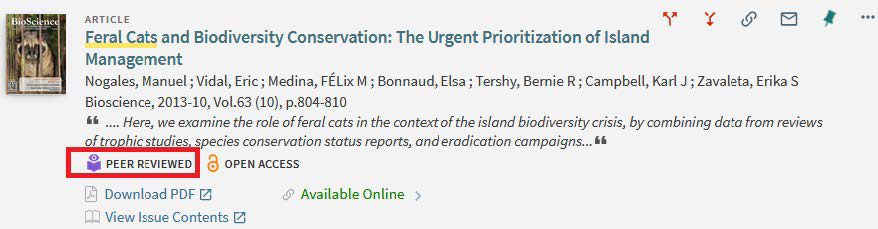
How do I find peer reviewed sources? The Library has access to a number of journals that are peer reviewed. The articles themselves may not state whether or not they are peer reviewed. Instead, you’ll need to look at the journal that published the article. Check the journal’s website for more information; if it’s not listed on the front page it may be on a page for authors called “Submissions,” “Submission Guidelines,” “For Authors,” etc. so that those authors know what to expect when publishing. Alternatively, the library’s search tool and many databases have filtering options that allow you to limit your results to just peer reviewed journals and may even add special icons to those articles to draw your attention (Figure 3).
Figure 3: A sample article search result.
The process for finding out whether a book is peer reviewed is a little less straightforward than it is for a journal. Check to see if the publisher is a “university press” (e.g., Rutgers University Press, University of Pittsburgh Press, University of Nebraska Press). However, some university presses also publish “trade” books for a more general audience, and there are some academic publishers that are not affiliated with a particular university (e.g, Parlor Press, Rowman & Littlefield, and Routledge).
However, not all material in academic journals undergoes this process. Pieces like editorials and book reviews, which are typically opinion-based, are often not peer reviewed even if they appear in an academic journal. However, they may have been written by an expert in the field. On the other hand, resources like newspaper articles may not go through much of a process beyond copyediting. This also depends on the publisher. For example, some major news outlets, such as the New York Times, employ fact checkers to double check stories before they are published.
Perform this investigation before you read the source to help you both interpret what you’re reading and to make the decision to jump to the next step of SIFT if appropriate.
What about interesting information you find on social media? Social media is almost never the original source of information. Not only do posts typically link back to an original article or source you can track down (see below), investigating who is reposting the information and why can be very informative. Similarly, influencers are often experts at sounding like experts. It’s critical to examine where and how an influencer developed their own expertise before using them as any type of source. Finally, social media rarely undergoes any of the editing and review processes detailed above. If you have found something on social media you may want to include in your writing, apply SIFT to find better coverage and trace claims!
After investigating a source, you may decide that you’re interested in the information it contains, but you are not impressed by the credibility of the source itself. Your next step at this point is to move away from the initial source entirely and find a higher-quality source that covers the same topic. Utilize the strategies for finding information outlined in Chapter 4: Starting Your Research to do this. If you find you are unable to find an excellent source with the same information, consider the possibility that the information was inaccurate, misrepresented, or not widely accepted.
This final step of SIFT goes hand in hand with finding better coverage. It’s common for authors and publications that are trying to inspire a specific reaction to leave out or overemphasize critical context when relaying information. As a very obvious example, a source could share a clip of a political candidate stating “raise taxes!” and fail to note that the candidate was answering the question, “What’s the last thing you’d ever do in office?” Sometimes a simple query in a search engine will reveal this type of missing context. Other times, you may need to dig a little deeper and find the unedited original version of information in order to verify a claim about it.
As you look for this, keep currency in mind. In both news and in scholarship, our understanding is constantly evolving. While it’s not critical to have the most current article—and in fact, this can be a problem as others haven’t had a chance to verify and respond to a brand new article—it is important to determine whether a source is current enough to have an adequate representation of a topic.
Tracing Social Media Claims: Leaving out important context or sharing information with incorrect context is a hallmark of social media. In one study, more than half of students who were asked to verify the credibility of a post on X (Twitter at the time), failed to even click the link in the post (Breakstone et al.). Checking to see if the information shared really came from when and where it was said to is critical. As Mark Twain said, “You can’t trust everything you read on the internet!”
While this process may seem like a lot of work, it actually happens pretty quickly. The initial assessment is only skimming or reading an abstract to determine whether or not the source is going to be useful. The more in-depth analysis using lateral reading also doesn’t require you to read through the entire piece. In this stage, you’re only trying to determine if the piece is credible by viewing information outside of the source you’re evaluating. Once both the initial assessment and deeper evaluation of the material is complete, it may be helpful to do another evaluation. This time, you’re double checking to ensure that the sources you picked are still relevant and useful to your research question.
Revisiting the sources you have collected and evaluated will give you one more opportunity to weed out any materials that no longer fit with your information needs. At this stage, reading sections with more details such as the methods, analysis, and/or conclusion will provide you with a better grasp of what the author(s) found in their research. As you read, consider your research question and the argument you want to make in your work. Do the authors’ conclusions, findings, or methodology support (or refute) any of the ideas you’re trying to answer? You may find that what you read in the abstract merely summarized the main points of the article or chapter, but did not confirm the conclusions or findings of the study. Depending on what you find, the article may or may not suit your needs. Not all of your sources will be perfect, and in some cases you might find yourself evaluating your entire list only to discover that nothing works. While this can be frustrating, it’s also a very normal part of the research process. Continue to narrow down your choices until you have the sources that work best for your research. Keep the ones that you feel are the most useful to read fully (see Chapter 4 for more on strategies for reading critically).
See Chapter 4 for a description of how Generative AI (GAI) functions. While GAI tools have a place in the reading and writing process, assessing sources is generally not that place for several reasons:
Chapter 6: Assessing Information and Evaluating Sources