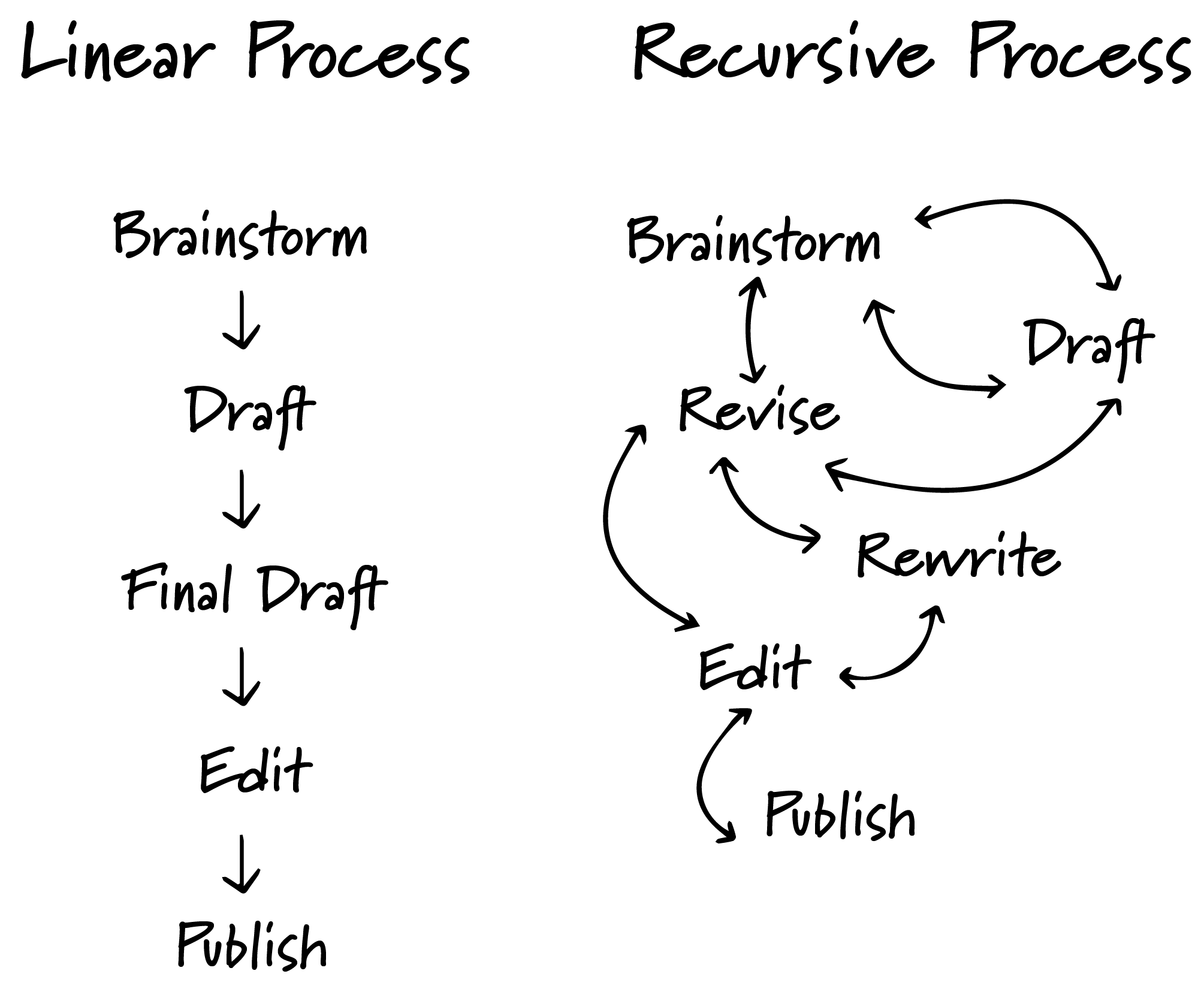
Figure 1: Linear versus recursive processes from "Rethink Your Writing Process: On Recursion," by Theo Abbruscato.
In order to develop as a college-level writer, you need to grow your reading skills in addition to your writing skills. This chapter provides an overview of how to develop critical reading and critical writing skills. Critical reading and writing are related processes. As you develop some of the reading and writing skills we discuss in this chapter, you may notice that they contribute to one another. For example, as you learn to pay attention to the types of texts you are reading, the choices authors make in their writing, and the effect those choices have on you and other readers, you are building rhetorical and genre awareness. The more you are able to step back from the ideas in writing and think about the rhetorical situation and effects, the more likely you are to be able to utilize this perspective as you make your own rhetorical choices when you write or compose other texts. This chapter provides definitions, strategies, and tools to help you build these important skills.
In “What Is College Reading,” writing and rhetoric professor Alice Horning synthesizes definitions of college reading provided by professors, educational policy experts, and administrators in secondary and postsecondary institutions to provide the following definition of college-level reading: “College-level academic reading can be defined as a complex, recursive process in which readers actively and critically understand and create meaning through connections to texts” (7). An article by Princeton Correspondents on Graduate Research states that critical reading is a process that starts “before the first page,” where the reader has to assume the position of a scholar and analyze the various writing choices made by the author. This is not to say that we need to look critically for any errors or biases in the writing, but rather think of how the writing may be improved.
Critical reading is part of the process of college-level reading, which can help prepare you for the reading tasks you will encounter in future courses and the work you will produce as a student. Even more than that, though, critical reading skills can help you learn how to process, analyze, and apply the ideas you encounter in the world around you.
Critical reading is a recursive process that involves specific types of thinking. For example, Michigan Tech’s Essential Education goals specify that all students should learn to think critically, which means that they learn to question assumptions, evaluate information, and analyze ethical implications. These abilities involve analyzing the relationships between your perspective as a reader, the ideas you are reading about, the source of those ideas, and the way those relationships shape what you do with the ideas and the texts you encounter. Think of this as the reading that you do in a few different types of scenarios:
When you engage in research, you will use critical reading as one strategy to help you sort through ideas, answer your research question(s), and understand your options as you write about your research. This form of active reading compels you to inquire beyond the written word in order to consolidate the text and your thoughts to present questions, discussions, and a more nuanced understanding of the text.
Quick Tip: Establish Your Purpose for Reading
We read for many reasons: to understand others’ perspectives and needs, to learn new information, and to entertain ourselves. Different types of reading call for different approaches to the reading task. For example, if you are reading for entertainment, you may find that being too critical of the ideas in the text interferes with your enjoyment. Conversely, if you are reading for research purposes, you will need to approach the text more critically. The questions below can help you think about your purpose for reading and how that purpose relates to various aspects of the reading process.
Critical reading techniques are like your personal toolkit for navigating through the complex maze of information that you will walk through while writing for academic purposes. Imagine each technique as a tool that helps you dig deeper, understand better, and retain more from what you read. Critical reading techniques help you with the following:
Critical reading helps you see beyond mere words, and into a metacognitive process of analyzing the author’s thought process, while simultaneously establishing your own position based on the analysis. Texts are not always easy to read—especially when the idea is to use the text as a source. Critical reading techniques simplify this process of comprehension by providing means to validate the source as useful for research. However, the very first step before you validate a source is to understand it in its entirety. This will involve reading and re-reading the text.
Quick Tip: Critical reading is not a one-stop process. The possibility is that, while gathering research, you will spend more time reading than writing.
Starting the reading process well in advance is crucial, especially in small-duration processes. Getting started early helps you get into the habit of actively engaging with what you read. You'll be more likely to question things, think deeply, and form your own opinions about the material.
Imagine meeting someone new and wanting to know more about them. You ask them questions about their name, origin, background, and interests to find commonalities between you. Similarly, when you come across a source you feel is a good fit for your own writing, start by answering questions pertaining to its main argument, perspectives, author credibility, and the logical entailment of its claims. This will help you uncover the similarities between your own research interests and the source, and may also provide insight into how you can integrate the source into your writing.
Imagine trying to solve a complex puzzle by simply glancing at the pieces without really examining them. Similarly, how you read and understand your sources plays a crucial role in determining the solutions and conclusions that you may draw for your own research questions. Critical reading helps you understand an author’s argument and decide your stance, that is, your personal agreement or disagreement with it. You may generate claims on the basis of your own subjective approach to the issue, and fuel it with objective, empirical evidence to provide solutions.
While exploring a new city, you may ask locals for directions, and make mental notes of interesting spots. Years later, you may still be able to recall the names of the places that you may have visited. Critical reading techniques demand active focus, which naturally reduces passive skimming and mind-wandering. Instead of passively receiving from the text, you are involved in the active process of communicating with the text through questioning, summarizing, evaluating, and reflecting on what you read. By finding relationships between known and new ideas, you are enabled to weave a “web” of understanding that adds more information to your current knowledge of a subject. As this process involves a higher level of cognitive function, it results in better knowledge retention.
Quick Tip: Critical reading is a process. Make sure to take breaks and split up the readings.
Most researchers would agree to the fact that the most taxing and time-consuming aspect of research is the reading that goes into it. However, this does not need to be the case. While you cannot reduce how much you may have to read on a topic, you can optimize your reading process to focus only on what is required for your specific research question(s).
Reading text more times than once may seem unnecessary, but more times than not, this practice helps you form a better foundation for the class and also aids information retention. Pre-reading involves 4 steps:
Active reading, unlike pre-reading, involves paying close attention to the minute details within the text. It requires doing more than just consuming words on a page. Your pre-readings equip you with a grasp of the author’s purpose for writing the text. From there, you can "chunk out" the text into various sections to determine how each section functions individually to attain the larger goal of the reading. You may also make short summaries, glosses, or annotations along the text as you read it, highlight sections that seem relevant, or create thought bubbles to jot down your own opinions around the text.
Some suggestions for marking up a text:
Based on your prior knowledge, pre-reading, and active reading of a text, you may have developed certain questions regarding the text’s viability for your research. It is important to acknowledge these questions and construct answers to them to assess the usefulness of the source. IOE Writing Centre suggests the following questions to ask while reading critically:
You can refer to this link for some additional critical reading questions.
More often than not, academic journals can be notoriously jargon-filled and, subsequently, difficult to read. By summarizing, you can filter out certain details from the information that you are reading and focus on keywords and phrases that are relevant to your research. This exercise also helps you to condense larger texts into smaller, concise paragraphs that are easy to recollect. An added bonus is that summarizing helps you to create a new body of text in your own words based on the material from the original source. You may also repurpose this text while writing your larger piece, with proper citation. For more detail on how you can achieve this, look at the section titled “Quoting, Paraphrasing, and Summarizing” in Chapter 6.
Quick Tip: If you are reading a text with many unfamiliar words, this can slow down the reading. To help with this, create a vocabulary list or a glossary of unfamiliar words to define.
Comparative Source Analysis: consider these questions as you move from reading to writing:
Synthesis and Worknet or Annotated Bibliography: Consider these questions as you move from reading to writing:
Journal Article: Consider these questions as you move from reading to writing
Evaluation is the process of determining the viability and the reliability of an argument. An argument consists of three components:
Claim: Tomato is a fruit.
Evidence:
Reasoning: Fruits are defined as organisms that are produced from flowering plants that contain and protect their seeds.
Sometimes, arguments that may seem sound superficially may be ridden with fallacies too. Fallacies are common errors in reasoning that undermine the logic of an argument. Keep an eye out for fallacies when reading and make sure to avoid them in your own work.
Of course, one would wonder—how can I develop my critical reading skills over time? While most critical reading techniques are metacognitive and developed through practice, the following are some tools to get you acquainted with the practice for the specific tasks below:
LucidChart is a diagramming application that helps you create mind maps, flow charts, and visual structures which aid in organizing your ideas and outlines before you start writing your paper. Based on the type of paper you are planning to write, you may choose to either pick one of the readily available templates or create your own. For the purpose of citing, you may pick material from your readings to be assigned to specific sections of your outline.
An app developed for helping students engage with reading material in a proactive manner, Perusall allows students to annotate a text in the margins and encourages collaboration by opening discussions around the annotations. It also assists students in interacting with one another beyond the classroom and helps them share their understanding of a text with their peers. If you are unsure about what a text means, you may simply add a comment and ask a peer for their point of view. You may also respond to peer comments and drive engaging conversations around the text.
An application similar to Perusall in terms of its functionality, Hypothes.is allows you to annotate web pages and add comments to various sections of a document. The comments made are stored within the Internet Archive and can be accessed with a plug-in.
The Reflect app can assist you in combining your notes, reflections, snippets, highlights, etc. in a seamless mode. You may add highlights from your reading device, reflections on text, recordings, and external links into the app and them combine them to form a cohesive reflection note on the material.
As you hunt for sources that may be a good fit for your journal article, critical reading strategies help you to narrow down what sources you will use. Start by looking into who wrote the information and when it was published. It will also help to read the abstract of the sources that you are referring to in order to get an overall view of the content within the source. This helps to ensure the source is reliable and relevant to your topic. Next, consider the intended audience of the publication—this can give you insights into the purpose and potential bias of the content.
As you read through your potential sources, critically analyze the author's arguments. Ask yourself: do the arguments hold up under scrutiny? Is there evidence to support the claims, and is it strong and credible? Keep an eye out for any bias—understanding the author’s perspective can help you evaluate the objectivity of the information. (Refer to the SIFT strategies in Chapter 5 for some ways of evaluating information.) By applying these strategies, you not only enrich the quality of your article but also deepen your grasp of the subject, leading to a more thorough and persuasive piece.
Activity: Critical Reading Workshop
Objective: To practice critical reading strategies for selecting and evaluating sources for a research article.
Materials Needed: A selection of articles from various sources, highlighters, and note cards.
Activity Instructions:
Group Formation: Divide into small groups, each group receiving a different article related to a common topic.
Initial Reading: Each group reads their assigned article, highlighting key arguments, noting the publication date, the author's credentials, and the intended audience.
Critical Analysis: Within your group, discuss the following:
Evaluate the strengths and weaknesses of the article's arguments.
Writing an annotated bibliography or a literature review requires more than just summarizing existing research; it demands a critical evaluation of the sources you are considering. To start, focus on identifying the most relevant and credible sources. Look at the authors’ qualifications, the recency of the publication, and whether the source has been peer-reviewed. This helps ensure that you're basing your review on reliable, authoritative information.
As you read each source, pay attention to the thesis and the main arguments presented. Evaluate the logic of the arguments and the adequacy of the evidence provided. Ask the following questions:
Understanding these elements is crucial for discussing how each source contributes to your topic. You may also want to consider how often the source has been cited or used in research. The more it has been cited, the more credible it may be.
Additionally, be aware of any biases the authors may have. Consider the context in which the work was produced and the potential influences on the authors’ perspectives. Recognizing these biases will help you present a more balanced view in your literature review. See Chapter 6 for more information on ways to evaluate the credibility of a source.
Finally, synthesize the information from your sources to highlight trends, debates, and gaps in the research. This synthesis is vital in demonstrating how your own research fits into the existing academic conversation.
To practice these critical reading strategies, try the following exercise:
Effective feedback, whether in academic, professional, or creative contexts, is based on the ability to read critically. When preparing to give feedback, start by understanding the text you are reviewing. Pay close attention to the main thesis, arguments, the evidence supporting them, and any author’s notes that may be included. Author's notes can provide valuable context, intentions, or limitations specified by the writer, which are crucial for a comprehensive evaluation.
As you formulate your feedback, consider the text's purpose and its intended audience. This perspective will guide your comments to be more targeted and constructive. Look for inconsistencies, gaps in logic, or unsupported claims, and suggest ways these can be addressed. You may also provide comments with specific suggestions and sources from your own understanding and knowledge of the subject. It's also beneficial to acknowledge what works well in the text, reinforcing positive aspects and effective strategies used by the writer.
When giving feedback, aim to be specific and objective. Provide clear examples from the text to illustrate your points, making your feedback actionable and helpful. By employing these critical reading strategies, including careful consideration of the author’s note, you contribute to a more productive feedback process, fostering growth and improvement in the recipient's work.
Quick Tip for Peer Review
Refer to Chapter 7 for more information about talking with others about your writing.
Critical writing is a skill that goes hand-in-hand with critical reading. In UN 1015, we focus a lot on writing processes. This means paying attention to all of the different things that happen as writers develop ideas about what to say, learn more about their topic, analyze their writing task, plan out their writing, get feedback from others, revise, edit, and share their writing with the world. The reason that your instructors, this textbook, and your assignments frequently refer to writing processes is that writing is a complex process that is rarely completed in one sitting.
Critical writing is a process in which you invoke your critical reading skills in order to compose an argument based on your research. Some examples of critical writing include analyzing multiple sources in order to understand your topic from multiple perspectives, drawing connections between sources and their ideas, and discussing your opinions on your topic in relation to research about the subject.
In addition, a core component of critical writing is selection. That is, critical writers make conscious choices about how they arrange their text, what information they choose to include, and what kind of language they use. The choices they make are all purposeful: to produce a text that has the most clarity and impact for a reader. Critical writing means that after the point of drafting, part of revision is to choose what content, organization, and language choices will be most likely to achieve your goals as a writer and for readers to be affected by your text.
Critical writing is not focused on accumulating pages or words: this may be a contrast from past writing experiences you have had in which meeting a page requirement or mandatory number of words for a writing task is a primary goal. For writers in the real world, your goals are as follows:
In other words, critical writers a) think carefully about the needs of readers, b) select and organize text in order to match those needs, c) aim for clarity, impact, and effectiveness in their language and syntax.
The relationship between critical writing and critical reading, as well as the relationship between different parts of a writing process, is recursive rather than linear.
In a linear process:
By contrast, in a recursive process:
Figure 1 shows a visual contrast between a linear process and a recursive one. Experienced writers often move back and forth between different parts of their writing process many times as they develop ideas and refine their thinking. Similarly, you may move back and forth between critical writing and critical reading as you work with this recursive process, so be sure to refer back to the previous section and to other sections of the book as you hone your critical writing skills.
Figure 1: Linear versus recursive processes from "Rethink Your Writing Process: On Recursion," by Theo Abbruscato.
Scholars in rhetoric and writing studies have focused extensively on the different kinds of work involved in writing processes and developed names for the different stages. The following sections provide an overview of the main stages of writing processes. The important thing to keep in mind is that you can always move between different stages. So, if you have started drafting and are struggling with a particular part of the draft, you are allowed (even encouraged!) to revisit some invention or research strategies to help you with that part of the writing task.

| Descriptive Writing | Critical Writing |
|---|---|
| reports on a source | explains, evaluates, or interprets the source |
| explains what happened | speculates or hypothesis about how and why it happened |
| states different positions | evaluates the merit of different positions and presents the position with the context of the writing task |
| describes a method or approach | explains why the method or approach is appropriate for the task |
| quotes and summarizes sources |
integrates sources for the purpose of arguing, reflecting, analyzing, or representing with a difference represents the writer's own perspective in relation to the source |
| restates the content of a source, summarizes | weighs the most relevant aspects of the source, prioritizing those with greater value to the writing task |
| lists information or summarizes information | makes choices to organize information, can explain those choices |
| provides options | determines the merits and drawbacks of different options |
Adapted from "Critical Writing," EAP Foundation. https://www.eapfoundation.com/writing/critical/
The first stage of a writing process, often called “invention” or pre-writing, involves coming up with ideas about what to say. This can include things like reading, brainstorming, freewriting, or discussion in which you think and communicate about the writing task (such as an assignment from an instructor or supervisor) and how you will approach it. For example, after your instructor shares a new assignment prompt with your class, you might start thinking about your topic by creating a list of ideas that connect to the topic. Or, you might search your textbook, a library database, or an online search engine for more information about some of the topics or ideas you’re considering. Another common invention activity is freewriting, which often involves writing anything that comes to mind for a short period of time. This can be a useful way to explore a specific idea you are considering for your writing task. Other invention strategies include:
Many writing tasks begin with some sort of prompt. The prompt might be an assignment from an instructor or supervisors, a call for proposals (a document from an organization or company that asks people to propose a particular type of work that they are seeking), or some other communication that asks for or requires a response. In other contexts, your writing might be prompted by a need or goal. One of the ways to begin working on a writing task is to review the prompt or gather what you know about the need or situation that your writing is responding to. If you’re writing in an unfamiliar genre, you may want to perform a brief genre analysis to find out more about the conventions of the genre you’re composing in. (See Chapter 3 for information about how to perform a genre analysis.)
Regardless of the writing task, one thing all communicators can do is to think carefully about the rhetorical situation you’re writing for (the audience, purpose, and context) and the genre that best fits that situation. (See Chapter 2 on “Foundations of Writing and Rhetoric” for more information about how to research the rhetorical situation.)
Another set of pre-writing activities involves researching the topic you’ll be writing about or taking an inventory of your existing knowledge on the topic. If you’ve already done some preliminary reading and research or if you have previous experience with the topic, you might start by freewriting about the topic and what you already know, or by creating a brainstormed list of ideas that connect to your topic.
In some cases, you might need to do research before you have something to say about your topic. Different writing tasks call for different types of research. (See Chapter 5, “Starting Your Research” for more information about research-based writing.) Whether or not your writing task requires you to find and cite sources, preliminary research can help you explore possible topics, think about the kinds of subtopics or examples that might connect to your ideas, explore what other writers have said about your topic, and/or narrow your focus. “Research” in this context can include anything from a Google search, to a library database search, to skimming through some books and articles, to asking questions of others, to looking at examples of similar work.
For example, if Roushan needs to create a meeting agenda for the next meeting of the MTU Mushing Club, her preliminary research might involve looking at previous meeting agendas and meeting minutes to see how meetings are typically structured and/or whether there are any topics from the most recent meeting that need to be raised at the next meeting. She might also check with the Executive Board and see if any of the other club officers have important business to discuss. In this context, Roushan will probably search her own email, the team’s Discord server, and communicate with others via email or text. And, as you may have noticed, there is some overlap between this topic research and analysis of the writing task that you read about earlier in this chapter. In a recursive process, the different stages are not always completely distinct from one another, and that’s okay!
Another form of invention and freewriting involves working with other people, as the previous example illustrates. There are many ways to work with others to develop ideas about what to write and how to write it. Many experienced writers regularly talk about their ideas with others in order to get feedback on their topic, brainstorm ideas; think about the connections between ideas or the structure of their writing, and consider the genres and rhetorical choices that will help them best reach their audience and achieve their purpose. Explaining your project topic or ideas to others and noting what questions or reactions they have can help you determine whether your ideas make sense to others or whether there are things that you need to explain or rethink. For example, Vershawn is getting ready to compose an email to members of his project team to update them about a project. His team includes electrical engineers as well as other project stakeholders. He mentions to his roommate that he is going to mention the PCB datasheet, and his roommate, who is not an electrical engineer, asks “What is a PCB?” From this interaction, Vershawn realizes that he needs to be careful about his use of acronyms so that all of his audience members understand the project.
Quick Tip: Talking It Out
Sometimes our writing
tasks call for writing in a specific kind of style or voice
that is different from the way we think or talk. As you are
learning to write in a particular style or voice, or as you
are thinking about how to express your ideas in that style,
you may find that you’re having trouble getting words out.
This is a great opportunity to get help from a friend, family
member, classmate, or writing center consultant. Talk through
your ideas about what you want to say with the other person
and have them take notes about what you’re saying (without
looking at the notes yourself). Or, if you don’t have someone
to help, use a voice recording! This can help you get the main
ideas out, which you can then revise to fit the writing task.
For many writing tasks, you will need to find information or explore ideas to help you determine what to say. Research can take many different forms: searching the internet, searching the library, reading a textbook, conducting an experiment, observing people or natural phenomena, or close reading of a text. The type of research that you need to do for your writing task will vary according to the topic, purpose, audience, genre, and context. For example, depending on your major or your previous education, some of the research processes listed above may be more familiar to you than others. If you are planning to produce writing from your research, careful note taking is a great way to make sure that you remember key parts of your research and have ready access to your work at other stages (such as drafting and revising). The research process, particularly the process of finding, evaluating, and using sources, is covered in more detail in Chapters 4, 5, and 6.
Thesis statements and topic sentences are important for critical writing because they help you define the focus and logic of your writing and make this clear to the reader. But not every college writing assignment or essay requires a thesis statement or topic sentence! For example, if you are writing content for a website, you probably won't need a thesis statement, but you may need to convey a main idea in each section, and you may not have long paragraphs with topic sentences because online paragraphs are often much shorter than paragraphs in, say, a research paper.
Some writing assignments that you complete in college, like a research paper or an analysis essay (especially in humanities and some social science writing), will require that you write a thesis statement. The purpose of a thesis statement is to concisely state the main idea of your paper. Generally, a thesis statement is located at the end of your introduction, but in some cases it may not be stated explicitly until the conclusion.
In the past, you may have been taught some rules or guidelines about thesis statements, such as they should have three parts which correspond to paragraphs in your essay, or that they can only be one sentence. However, as you complete more complex college writing assignments, you need greater flexibility and these rules don’t always apply. Your writing will likely be much longer than three paragraphs and you may need to write thesis statements that are multiple sentences or even expressed in a full paragraph.
The first thing you want to do when writing a thesis statement is consider what your assignment asks you to do. For example, if you are completing a research paper, your thesis will generally be the answer to your research question. If you are completing a literary analysis, your thesis statement will generally focus on an element of the work such as character, theme, imagery, etc.
Expect your thesis to mature throughout the writing process and remember that papers will sometimes include a purpose statement (see Chapter 2) instead of or in addition to a thesis. A topic sentence is like a mini-thesis statement which gives the main idea of a paragraph, rather than your whole paper.
A topic sentence allows you to demonstrate how the paragraph contributes to your paper. Not every paragraph needs a topic sentence—the function of the paragraph might be implied or indicated by a transition. Like a thesis, there is not just one way to write a topic sentence, but multiple. The chart below shows a few different approaches to writing topic sentences:
| Common Types: | Example: |
|---|---|
| The Direct Approach |
It explicitly announces the purpose of the paragraph. Example: The purpose of this paragraph is to explain why colleges should lower tuition. (Typically used in technical writing, scientific writing, or speeches.) |
| The Question |
It indicates the paragraph's purpose by posing a question it will answer. Example: Why should we debate this issue anyway? |
| The Nutshell |
It states the main idea—not the purpose—of the paragraph, usually in just one sentence. Example: Before long, I realized my aunt was sick. (This is probably the most common type of topic sentence in college writing.) |
| Addressing the Reader |
It anticipates what readers might be wondering about or doubting. The paragraph provides a response. Example: You might be wondering why it is necessary to build a new stadium. |
| Connecting to the Previous Paragraph |
It makes a clear link with the preceding ideas. Example: Let me offer one example of this concept. |
| The Alert |
It calls special attention to a point the paragraph will cover. Readers should understand the importance of the paragraph. Example: It would be a mistake to assume that students don't care about racism. |
| Transition Words List | |||
|---|---|---|---|
| Emphasis | Order | Reason | Contrast |
|
|
|
|
Drafting is the part of the process in which you create the text. If you’re working on a document, it begins when you open a notebook or document and start writing. For other types of writing, such as a poster project or a presentation, you might draft in more than one application or genre.
There is no one “right” way to draft; there are many different ways to think and to write, and the most effective way to draft may depend on how you think, how well you know your topic or genre, and other factors like the time and resources available to you.
Many writers find it helpful to begin with some kind of plan, which might be:
Beginning with a plan is one reason that many writing classes focus on writing processes such as invention, which help writers develop ideas about where to start their writing project or what they might want to say. Planning can help you organize your ideas, stay on topic while you write, and keep in mind key elements of the rhetorical situation such as your purpose and audience. Many writers veer off topic if they write without referring back to their plan or their task. This isn’t necessarily a bad thing if the writing task allows you to develop new ideas; since writing is a way of developing your thinking, you may find that you reach new understanding or insight on the topic through this process. However, writers typically need to return to their plan periodically to make sure that their work is achieving the key goals and/or appropriate for their audience. So, as you draft, consider working with some kind of plan and checking it every so often. If you’re not sure what type of planning works best for you, try some different options to see what works best for you. Keep in mind, too, that different writing tasks may involve different kinds of planning, so not all of the strategies above would be applicable to every genre or situation.
Having some initial ideas about what you need to do or what you plan to say can help relieve the pressure that some writers feel when looking at a blank page. Another way of keeping your plans and goals in mind is to use multiple documents. Having your draft open on one side of the screen and an assignment sheet or source on the other side, for example, can help you move between different sources of information.
If you break down the word “revision” to its components, “re-” (a prefix meaning again or suggesting repetition) and “vision,” in the sense of “understanding,” then "revision" means to review your writing and to check for your own and others’ understanding. When writing experts talk about the revision process, they distinguish it from the process of editing or proofreading, which involve looking for minor changes such as typos, sentence structure, word choice, misspellings, and punctuation. In contrast to these “surface-level” issues, revision involves looking at what we sometimes call “global” aspects of the text:
Feedback is often a part of revising. Experienced writers often share their work with colleagues, friends, family members, or even some members of their audience to get feedback about how well their work is accomplishing its goals and reaching its audience. Part of the value of this is that readers can help point out things that you may know but your reader doesn’t—and your reader will see the text in a different way because they haven’t been looking at it over and over again during the drafting process. In a writing-intensive class, revision will probably involve creating and submitting at least one draft and completing a peer review or conference with your instructor to receive feedback on your work. If you are seeking feedback from others on your writing, whether or not that feedback is part of a formal peer review, it is usually helpful to provide your readers with some information about the rhetorical situation (such as your purpose and audience) and some direction about what you would like feedback on.
However, even if you don’t have someone to read your work, you can do a great deal of revision by reading and rereading your own writing. Because research and writing are ways of thinking and developing ideas, many writers have much more refined and in-depth knowledge of their topic the further along they are in their writing process. During revision, you can use this to your advantage by revisiting the main components of your writing project to see if your ideas about, say, your argument or the main topics you are discussing, could be more specific or detailed than your first draft. Many writers find it helpful to take a significant break between completing the draft and rereading it for revision; this can certainly affect how you perceive the text. If you do not have the time or space for a long break, you can do other things to change how you see the text such as printing a copy, changing the font, or reading aloud. (See Chapter 9 for more ideas about how to reread your own work.)
In addition to developing this new understanding of your writing by getting feedback from others or your own rereading, you will also need to use that knowledge to make choices about how to change the text.
Some additional strategies for revising your work include:
Once you have some ideas about what to revise, make a plan in which you prioritize the revisions you will complete. Typically, starting with revisions that will affect the text as a whole or major sections of it is advisable because smaller changes might become irrelevant if large portions of the text are going to be reorganized or rewritten. Similarly, if material needs to be added or moved, things like explanations or transitions might shift because of that reorganization, so the latter would be easiest to save for later. For example, if you and a friend read your draft of a research paper and you realize from this process that you need to add evidence to support one of your points, reorganize the paragraphs, and write a new paragraph to address a missing component, you might decide that your top priority is to add the new paragraph because it will help you ensure that your paper meets one of the assignment requirements.
Once you have completed one or more revisions and have a complete draft that meets your goals, you will most likely complete some editing or proofreading. Editing typically involves reviewing the draft for minor changes such as word choice, typos, punctuation, formatting, style (e.g., to make sure your writing and citations meet the guidelines of the style guide or other guidelines). Some writers find it helpful to read the draft aloud, print a copy, or change the formatting to help them see the text differently. When we know the text well, our brain can sometimes skip over things and that might make it hard to notice things like missing words or punctuation issues. Some other helpful strategies can involve reading backward to forward, reading through for specific issues or problems (e.g., if you know you tend to make a specific spelling or punctuation mistake), or starting with the areas that need the most work.
Reflection activity:
Consider one or more statements issued by the Conference on College Composition Communication about tone, voice, and linguistic diversity, linked below. In what ways are expectations about academic tone and voice linked to particular cultural ideas about "correct" or "proper" language use?
If you have trouble beginning a draft or getting words onto the page, consider allowing yourself to write more freely than you think the genre calls for. For example, if you’re writing a lab report that calls for the use of passive voice and the third person but you’re not used to writing that way, allow yourself to write out what you did as though you’re describing it to someone you trust and feel comfortable around. At the drafting stage, the top priority is getting ideas written, regardless of how polished they are. Similarly, if you find yourself imagining an inner critic while you write, see if you can ignore that voice or try picturing someone who is less critical. If you are your own inner critic, consider dimming your screen so you can’t see what you’re typing, covering previously drafted material so you can’t reread it (by resizing your window, for example, or scrolling to leave only the line you’re currently typing on the page, or even by talking out your ideas using speech-to-text or by recording a voice memo that you later type up).
Some writers do very well at revising while they compose, but if you find yourself struggling to write because of this drive to perfect each sentence, try to just get the words out without correcting them. You can revise later to better fit the genre.
Keep in mind, too, that you do not need to draft by starting at the introduction and ending at the conclusion. You can write any section you want first, and sometimes getting something on the page helps you get going, so try starting with the easiest part of the writing or the part you are most excited about.
If you struggle with motivation or focus, consider writing in short sessions, taking short breaks, and coming back to the writing often instead of trying to write everything at once. You can draft one paragraph or section at a time, for example, or write for 30 minutes at a time. Some writers use word count goals, such as writing 100 words. In between your short sessions, take a short, five-minute break to do something you enjoy (but that won’t distract you from returning to the task). Examples include a brief walk, spending a few minutes with a pet, doodling or coloring, looking at something you enjoy (out a window, at art on the walls, etc.) or talking to a friend (texting or in person). If you find that you have trouble returning to the task, you may need to declare some things “off limits” (such as your phone, social media apps, or certain places) during the times you are trying to focus and set a timer during your breaks to help you return to your writing. The important elements of this strategy are to have a clear goal in mind for what you will accomplish (and the goal should be small enough; “write the paper” is too big of a goal), a way to track progress, and a way to give yourself small rewards for making progress.
If you encounter a problem or block that is stalling your writing, consider making a note of the problem for later and moving on to a different section of the writing. There is a stereotype among people who do creative work that we get our best ideas on a walk or in the shower. Scientists who study creativity have found that there is some basis for this popular idea, and sometimes keeping your project in mind but doing another task like exercising or cleaning (especially if you allow your thoughts to wander) may lead you to a solution.
Some other strategies for addressing problems that come up in the drafting process might include:
It’s difficult to do the work we need to do without having our needs met, so try to be mindful of what your body is asking for.
Some writers try to end their writing session with a brief note about where they are stopping and what they need to start with when they come back to the writing. This can be helpful if you are stopping for the day, for example, so that when you come back to the project you don’t have to reread and remind yourself where you were.
Another important aspect of critical writing is metacognition, or an awareness of your own thought processes. When writing, metacognitively reflecting on what you’ve written and how you got there can serve to improve your writing craft. Here are some examples of metacognitive questions you can ask yourself:
In addition to metacognition, talking with others about your writing is a way to improve your critical writing skills. For more information about talking with others about your writing, see Chapter 7.
Chapter 4: Critical Reading and Writing