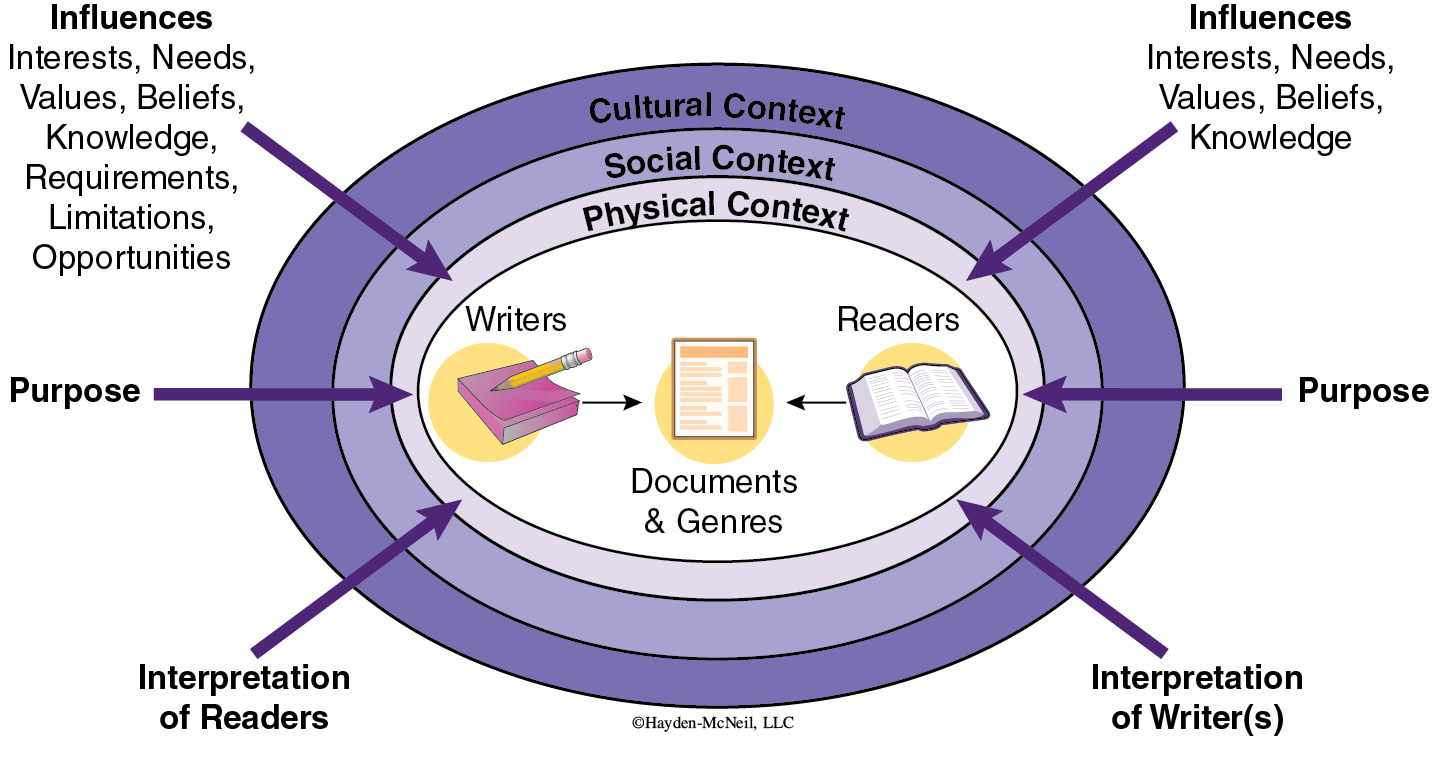
Image of the rhetorical situation used with permission by Mike Palmquist. Understanding Writing Situations. The WAC Clearinghouse.
As a new college student, you have spent lots of time writing for different academic purposes across different courses and levels. As Shirley Rose writes in the book Naming What We Know: Threshold Concepts of Writing Studies, “all writers have more to learn," and all writers are in a continuous process of growing and expanding their skills as they encounter new readers, contexts, and purposes.
As a result, writing requires effort to hone, especially if you were taught one specific way to write. Just as tools are designed with specific tasks in mind, writing methods work better for some contexts than others. Just as there are as many ways to process information as there are people, so are there as many kinds of readers as there are writers. Those who understand these nuances between audiences and can make choices that meet the needs of diverse readers will be more likely to successfully achieve their communication goals.
An effective writer is aware of all possible readers who may process their work, instead of pushing one format to fit with other genres they are familiar with. Effective writers also consider how language is influential within the realms they write in, and what effects it produces. Understanding the who, what, when, how, and why of an audience unlocks more ways to appeal to them. This chapter explores aspects of audience, purpose, situation, and genre, to help you grasp these concepts as you become an effective writer.
All texts have an audience. Whether you’re writing a reflective journal entry or a speech to give at an event, your writing is influenced by conventions that an audience expects. At the same time, writing that is produced to be read out loud (like a speech or presentation) has the advantage of receiving instant feedback so you can adjust as needed; writers, however, as much as possible, have to anticipate what readers might think as they encounter the text. Some disciplines refer to this skill as perspective-taking, “or [the] ability to perceive things from a point of view other than one's own” (qtd. in Abocigalu, Volman, and Fischer 739). For writers, it can seem like this means you have to take on an infinite number of perspectives given depending on the reach of the text. However, don’t be intimidated by this writing responsibility—most texts are written to specific audiences, so effective writers primarily need to practice thinking like or about their potential specific readers.
Let’s say that you’re writing a lab report for your chemistry class. Who would be your audience? Most likely, your instructor would be reading your report. In that case, it’s important to ask whoever is reading your report what expectations they have. What tone do they except in your writing? How do they want you to structure the paper? Some of their expectations may be general for the lab report genre, but other expectations may be specific to the class. In other words, what conventions may work for one instructor may not apply to another.
Therefore, it’s crucial to either ask and/or research your audience to determine what their expectations for your writing are. What are some ways to determine or think through your reader's/audience's needs?
As you approach a writing task, consider some of the following questions:
There’s no doubt that when one writes for an audience, there may be disagreement as to what expectations and goals are for a piece. How an author communicates their point may not agree with what the audience expects of that piece, especially if the author breaks several genre conventions beyond expectation. Resistance for audiences to continue reading the author's work may occur, meaning the author’s words go unheard. So when is it appropriate to set aside reader expectations, or if the author sets aside their expectations, to cater to the audience?
In reality, there is no concrete answer. Just as setting, audience, and purpose vary from situation to situation, so do expectations of a given writing piece. The best way to approach this question of author expectations versus audience is to ask yourself: what is the expected action I have for my audience? Do I want them to walk away with a different viewpoint? Do I want them to consider my opinion on a particular issue? Do I want to make them feel happy or challenge them with thought-provoking imagery? If you can confidently answer what you reasonably expect your audience to respond to your writing, then you can determine the purpose of your work!
All communication has a purpose. No matter what you write or who you write to, there is a reason that you compose a text. Understanding the purpose of a text assists you as a writer in understanding what makes writing work.
As with other communications, there are numerous purposes to writing. There are even instances where your writing may contain two or more purposes, which is normal! Our audiences and situations can get complex enough that the purpose reflects this complexity to best address the situation.
There is no single purpose for a text; purpose is inextricable from genre. Consider some of the following purposes.
You may write in genres that have an informative purpose. Informative writing focuses on providing clear, concise information for its audience. An informative piece can be effective in delivering content that is otherwise distorted by other figures of speech. With informative writing, audiences may expect a tone from the author, one that appears all-knowing or omniscient. In these contexts, audiences place trust in the author to deliver the information as accurately and as clearly as they can. Informative genres can include reports, white papers, or other genres whose primary purpose is to transmit information.
Your audience is inundated with information every day. They are reading billboards, watching television, using social media, getting emails, seeing menus—countless forms of information surround us. When you approach the task of informing your audience, you want to both provide them with the best sources of information and make meaning of those sources—to share that information according to the writer’s (you) and reader’s (the audience’s) needs.
When you are informing your audience, you might be trying to:
Oftentimes, people will say that presenting information is a neutral or objective activity. Although you, as a writer, may do your best to remain objective and neutral throughout your writing, all writing has a persuasive quality. For example:
The persuasion aspect of informative writing might often fall on your ethos as the writer or speaker. You are showing that you are credible and have the authority to speak on a topic.
It is important to remember that writing to inform does not happen in a vacuum. When you are informing, you are approaching the situation through a lens made up of your own experiences, such as your culture, region, and the education you’ve had. When you write to inform, you are reading through sources and interpreting them in your own way. When you report information, you are putting information into context based on your interpretation—although you may work to be neutral and objective, authors can never be 100% objective or neutral.
Writing can also act as a persuasive vehicle for ideas and thoughts. Persuasive writing provides claims and reasonings to back up points the author is making for their audience. Similar to informative writing, the information is ideally provided with accuracy and clarity, yet a persuasive piece utilizes rhetorical devices and persuasion strategies more so than an informative piece. Writing to persuade an audience requires an inherent understanding of their expected voice and tone so that the audience relates to where the author is communicating from. An example of persuasive writing might be an advertisement or argumentative essay.
If you are asked to write an essay or create another kind of text that is persuading or arguing, this means that you as the writer are providing a compelling case. It is different from what you might have written called "opinion," because argumentation requires extensive supporting evidence or documentation, so it's closer to an "informed opinion." Likewise, persuasive writing might overlap with argument, but it draws upon what are referred to as "rhetorical appeals," and is intended to change how readers/listeners view a topic. There is significant intersection between these two genres but they do have distinctions. For example:
When you pick up a novel or look over a poem, you’re most likely not expecting to analyze information the same way as with a scientific or rhetorical piece. Writing can simply entertain its audience. It could do so through narrative, humor, or other appeals to emotions. You might be asked to produce writing for this purpose in a course on creative writing, in the visual and performing arts field, or in public speaking.
Telling stories, or including narratives, can add to your writing by increasing credibility or emotional appeal. It can help you maintain a pace for readers, as well as create a human connection to your ideas. You should only use this when appropriate for the style of writing, and you must be careful to not overly appeal to emotion through your writing. By including too many anecdotes, your reader might think that you do not have enough substance in your actual argument and are relying on anecdotes or narrative to do your work for you.
Use of stories will look different depending on what you are writing. There are times where including a narrative about yourself will enhance your writing and reveal any potential limitations or specific views you may have. It can also be helpful to think of writing academically as having storytelling elements. For example, you want to build to a climax where you reveal your most compelling evidence. You want your reader to maintain interest throughout your writing, and have a main idea (your thesis) that is maintained throughout the paper. You want to construct honest conflicts, which means revealing counter-arguments to your ideas clearly and honestly. By fully sharing others' ideas, instead of saying “many people believe…” you can specifically address other ideas and then explain why yours are most appropriate to the situation at hand.
Lastly, consider pacing as an important aspect of writing. When academic writing has too many facts and descriptions all at once, it's like a fast list that doesn't let readers think. Add some thinking parts to give readers time to understand.
On the other hand, if there's too much talking and explaining in academic writing, it gets boring and makes it hard to understand what the writer is trying to say. Stick to the important points and keep going.
You will often be asked to write for analysis purposes in college, across a variety of disciplines. Analysis writing involves breaking apart a concept, idea, event, theory or some other complex entity and identifying how it works or what its component parts are. This is sometimes called “systems thinking.” Whether it is the parts of poem and their effects, the way an engineering component works, or a complex approach to computer programming, analysis is a core part of what students practice in college writing.
Analytical writing will often address the questions of “how,” “why,” and “so what?” As a writer, your approach should be both evaluative and critical of the topic. When you do analytical writing, you are
As an analytical writer, you are seeking to uncover meaning and move beyond descriptive writing, or just reporting information to your audience. When it comes to writing a research paper, scholarly article, or the discussion section of a report, you'll want to maintain an analytical voice and engage with ideas. For example:
These two sentences show the difference in descriptive vs. analytical writing. In the first example, the author is simply stating what the article they’re using is about. In the second sentence, the author is looking at the significance of the study and making meaningful connections to discourse in the field. Both descriptive and analytical approaches will serve you well in writing, but be mindful of when it is more helpful to delve deeper into ideas or when you just need to report ideas.
When it comes to writing analytically, ask yourself:
Learning how to do analytical writing in college will be helpful in the workplace, where employers, clients, and colleagues want to get to the significance of issues and learn your understanding of them.
See Chapter 4 for more information on Critical Writing.
Sometimes, writing doesn’t have a set end goal. It may meander and explore tangents while circling back to some main goal in mind the author may or may not reach. In this instance, the purpose becomes the journey the author takes to reach their main point of emphasis. It may appear chaotic initially. Exploratory writing becomes the basis of thought experiments.
You might read or write this kind of text in a philosophy, creative writing, or journalism course. It can also be a helpful tool in courses that don't require it (e.g., if you are thinking through your ideas or approach to a topic). The purpose is to use writing as a tool for thinking, to map out possible avenues of thought, and to develop insights into your own views.
Some principles of exploratory writing:
In addition to its uses for various academic purposes, many people also find exploratory writing personally helpful for their thinking or self-understanding and use it to sort through complex situations or difficult decisions. Some people use journals, blogs, or social media posts for exploratory writing.
Taking time to reflect on how far you have come in developing your writing and researching skills is a good way to not only look back, but also look forward to how you can put into practice what you have learned when you take future classes and eventually to the workplace. Sometimes when you write, you need to sit down and consider what’s occurring in your mind. You may need to capture your thoughts through introspection; when recording procedures for transitioning positions, or when reporting to your supervisor. Reflective/process writing is how you observe and interpret your world and yourself in a manner that’s understandable for you and your audience.
Because developing writing and research process knowledge is one of the core outcomes of this course, you will be asked to write for this purpose fairly often this semester. Reflective writing taps into metacognitive knowledge, which refers to your awareness of your own thinking: the “ability to use prior knowledge to plan a strategy for approaching a learning task, take necessary steps to problem solve, reflect on and evaluate results, and modify one’s approach as needed” (Kafka). In other words, metacognitive knowledge is “the ability to think about or control your own learning” (Vacca and Vacca qtd in Kafka).
Metacognitive knowledge includes both self-knowledge, or the knowledge you have about yourself as a learner, and task knowledge, or awareness of the skills and strategies that are available to you (Kafka). Developing metacognitive knowledge is crucial as you develop your writing habits. Engaging in reflective writing about your process will help you identify what works for you.
To help guide your reflection and vision, try the following exercises:
Reflecting to see the Future:
Reflection: What did you learn? What were some of your personal connections to the projects, lessons, or class activities?
Vision: Where do you see yourself applying what you learned over the semester? How can you apply what you learned? When can you apply what you have learned?
Literacy Narrative:
Reflection: Write an informal reflection on how institutions have shaped your literacy. Consider different writing instruction you’ve had over the years, including in elementary school, up until your experience in college.
Vision: Think about how writing instruction has changed from learning how to physically write to writing college papers or writing in various workplaces. How do you envision it changing as you become a workplace writer?
These are just a few possible kinds of rhetorical purposes, and it’s important to recognize that these are not an exhaustive list. What’s essential to recognize is that you will encounter multiple types of writing purposes as a college writer, many of which will be new, and this is all part of becoming a proficient writer.
In college, when writing for a particular assignment, sometimes the purpose will be given to you. But other times, it will not be clearly stated—you will have to assess it yourself and make choices accordingly. This is also true for most “real world” writing situations you will encounter after college. Early research has found that an important factor in whether college students produce successful writing is their ability to understand the writing task and approach it accordingly (Irvin).
A related concept to genre, context, and tone is the idea of formal or informal writing.
In formal writing, a writer is expected to adhere not just to genre conventions but also stylistic choices, ideologies, and other nuances that keep the writing’s formatting consistent amongst other similar works and with the level of distance that is shown through tone and word choice. For example, writing an academic essay would be considered formal writing because the writer tends not to address the reader directly or use slang terms. By following the criteria in place for formal writing, the piece gains authority in the sense that the author appears trustworthy. They understand who their audience is and how the information should be delivered, therefore, the writing and its author should be taken seriously in discourse. Participating in formal writing is how one can speak out in an otherwise restrictive space.
Don’t let the term “informal writing” fool you into dismissing
the formalities behind this type of writing. There are still
stipulations as to what’s appropriate or not with informal
writing. The main factors in determining what constitutes
informal writing include the cultural context in which it is
presented. For example, slang changes in meaning, so what one
word means might change rapidly over time (and either become
outdated or offensive) or from one situation to another.
Informal writing is especially common outside of a professional
or academic setting, but even within professional, academic, and
personal contexts there are writing occasions that call for
different levels of formality.
When writing for
UN1015, the distinction between formal and informal writing can
be helpful when comparing core assignments and process work.
Core assignments are an example of formal writing. When you
submit these to your instructor, they are expected to be more
polished. In contrast to this, process work is the in-class
activities and other assignments that help you develop your
writing skills along the way. These can be more informal in
nature.
Similarly, in many academic and professional settings, it's
common for an initial interaction (for example, an email to your
professor or to a colleague or client) to include more formal
components (such as a greeting and signature, for example), but
in some situations, subsequent messages may drop some of those
formal conventions.
Within formal and informal
writing are numerous purposes one can work with to achieve the
specifics of their setting. Consider these following two
passages addressing the same issue but with different tones.
| Formal | Informal |
|---|---|
| The first semester of college can be a challenging time for new students. For traditional-age students, the experience may include living on their own for the first time, taking responsibility for managing their own time and workload, and perhaps balancing their schooling with paid work. They have limited contact with their professors due to shorter and less frequent class periods and perhaps very large lecture classes. Forming new social groups can be exciting but also stressful. | You don’t always expect it because people talk about college a lot, but in actuality it’s a big transition for students. I definitely found it hard because I was living on my own for the first time, and I was used to my teachers and parents helping me keep track of my work and when it was due. I was definitely used to every teacher knowing my name, and instead I was in class with 200 other people. I also had a close group of friends in my town, then went to a school where I did not know very many people, which was tough. |
Discussion questions:
Something else you will want to consider when reading and writing is context, which can include the time, place, and culture surrounding a text. Writing doesn’t happen in a vacuum, and this affects the choices that writers make and the way a text communicates its message. It also shapes the level of formality that is expected in different settings.
How something is written and understood is influenced by the culture in which it was written. A society's language, customs, and shared values are all part of its culture. Based on a three-year ethnographic study into academic lecturing conducted at a university in Hong Kong, John Flowerdew and Lindsay Miller developed a four-dimensional culture framework that can be applied in cross-cultural contexts. This framework offers a critical strategy for identifying underlying cultural elements in a piece of writing.
Aspects of culture are multiple. For example, these could include ethnic and local cultural features and norms like differences across countries and communities. Flowerdew and Miller, for example, recognized in their study the need for lecturers to use examples that are local or that would be recognized locally. They observed that students in Hong Kong did not understand when lecturers gave examples from the U.S. and this was a barrier to their understanding of the topic.
Aspects of culture might not be based on cultural community or location but on shared interests and constructed spaces. For example, academic culture refers to the particular values and patterns of behavior which are specifically academic in nature. Academic culture is influenced by practices of the ethnic culture in which it is situated. For example, Flowerdew and Miller’s study showed that in Hong Kong, academic culture is typically teacher-centered rather than a participatory style that is more expected in Western academic culture. While much of this book focuses on introducing you to the generally accepted practices for writing at the college level in the United States, it is important to remember that these practices are not universal. Likewise, academic disciplines can have their own cultural norms.
Another relevant context for writing is the context of an academic discipline. An academic discipline is a field of study that is taught and researched at the university level. For example, the discipline that informs this textbook is composition/writing studies (i.e., the professional field of writing, research, and instruction). Disciplines are defined by formal structures such as discipline-specific academic journals where research is published, departments or academic programs within universities, and professional organizations or conferences where scholars network within the discipline. There are many ways disciplinary context affects the way that people communicate: there can be variation in style of teaching (lecture- and content-heavy versus applied or active), what kinds of questions are explored, what kinds of information and evidence are considered valid within the field, and what methods of creating knowledge are used, what kind of terminology and jargon are used, how papers are structured, etc.
When reading, be attentive to what discipline a particular source comes from—knowing the disciplinary context will help you understand the source and also help you understand how people write in that field. Additionally, as you go throughout college and do more courses in your major, you will begin to enter that discipline and naturally become more familiar with it.
Another useful way of thinking about context in your writing is through the concept of a discourse community. Discourse communities, according to linguist John Swales, are "groups that have goals or purposes, and use communication to achieve these goals." Discourse communities in academia are typically characterized by disciplines, but discourse communities exist in more than just academic situations. Dan Melzer uses the example of joining an acoustic guitar jam group. This community has shared goals of learning new songs and playing guitar together. As he joined the group, Melzer learned that the group had established practices for what kinds of songs they play and used specific vocabulary like beats per measure and octaves.
Reflect: Think about the kinds of activities you engage in and whether they involve specific groups of people. Discourse communities do not need to call themselves discourse communities in order to be operating as such.
Examples could be academic disciplines, workplaces, hobbies or extracurricular activities, and religious communities, but there are many more discourse communities. As you consider what might count as a discourse community, pay attention to the examples and definition above.
What discourse communities are you a part of?
Something to keep in mind is that context shifts depending on how and where a text circulates. Circulation is used in composition studies to refer to the ways that information is transmitted, and how texts are used. Social media is a great example of this—think of a post that originally appeared on one platform being reposted on other social media sites or quoted in news articles. This causes the text to take on new meaning as it circulates to new contexts. A news article reporting on a political candidate's recent remarks might be represented and reused in different ways depending on the space it appears. As a result, writing and rhetorical practices are evolving as a result of the expansion of the internet and the speed at which texts circulate. It is always a possibility that a piece of writing will be taken into a different context than it was originally written.
Throughout this text and this course, you will hear the term “rhetoric” or “rhetorical” referred to in a number of ways. Though there are traditional ways to define rhetoric that focus on persuasion, or ancient Greek traditions of speech-making, the term has evolved more generally to refer to the ways that communicators use language to accomplish a particular purpose. The important thing to understand is that language is never deployed neutrally, and that this is not a bad thing. As literate and communicative entities, it’s actually quite amazing how tactical and efficient people can be as they work to understand others and be understood. Rhetoric is the study of how people use language for particular purposes and what choices they make to accomplish those purposes.
A rhetorical situation, then, refers to the set of circumstances in which a writer creates a text. The most important thing to know about a rhetorical situation is that understanding it can help you make effective writing choices. We have already explored how the basic components of a rhetorical situation (i.e., audience, purpose, and context) can affect the way you write and interpret texts. However, a rhetorical situation can also include more than this:
“rhetorical situations are embedded in contexts of enormous social complexity. The moment you find a subject, you inherit all the knowledge, history, culture, and technological significations that surround it. To lesser and greater degrees (depending on the subject), you also bring personal circumstances into the field—perhaps your gender, your race, your religion, your economic class, your habits of language. And all those issues weigh also upon the people you write to and for” (Ruszkiewicz & Lunsford).
The diagram below depicts some of the many factors that are impacting a rhetorical situation:
Image of the rhetorical situation used with permission by Mike Palmquist. Understanding Writing Situations. The WAC Clearinghouse.
Some scholars have pointed out that typical configurations of the rhetorical situation can be limiting. For example, Jenny Edbauer observes that rhetorical situations involve many things that can’t be segmented into categories, and models that do so can obscure the way that rhetorical situations are flexible. For this reason, it may be more helpful to think of a rhetorical situation as a rhetorical ecology. The term "ecology" focuses on relationships, and a rhetorical ecology places more emphasis on the interaction between the variables that affect a rhetorical situation rather than on individual elements separately.
This can help account for the nearly infinite interconnections among different elements in a situation. Margaret Syverson uses an ecological view of writing to explain that writing is more than an audience, writer, text, tools, and ideas in static relation with each other. Instead, writing is a series of events, such as using a keyboard; the writer's experience within a comfortable or uncomfortable space, and the activity of writing alone or in different group settings, whether enthusiastic, indifferent, distant, or close. Overall, each rhetorical situation is unique, complex, and constantly changing. It is important to always be aware of the rhetorical situation, and an important part of becoming a skilled writer is to consciously make choices based on the audience, purpose, context, and more.
Class Discussion and Reflection Questions for Chapter 2
Chapter 2: Foundations of Writing and Rhetoric